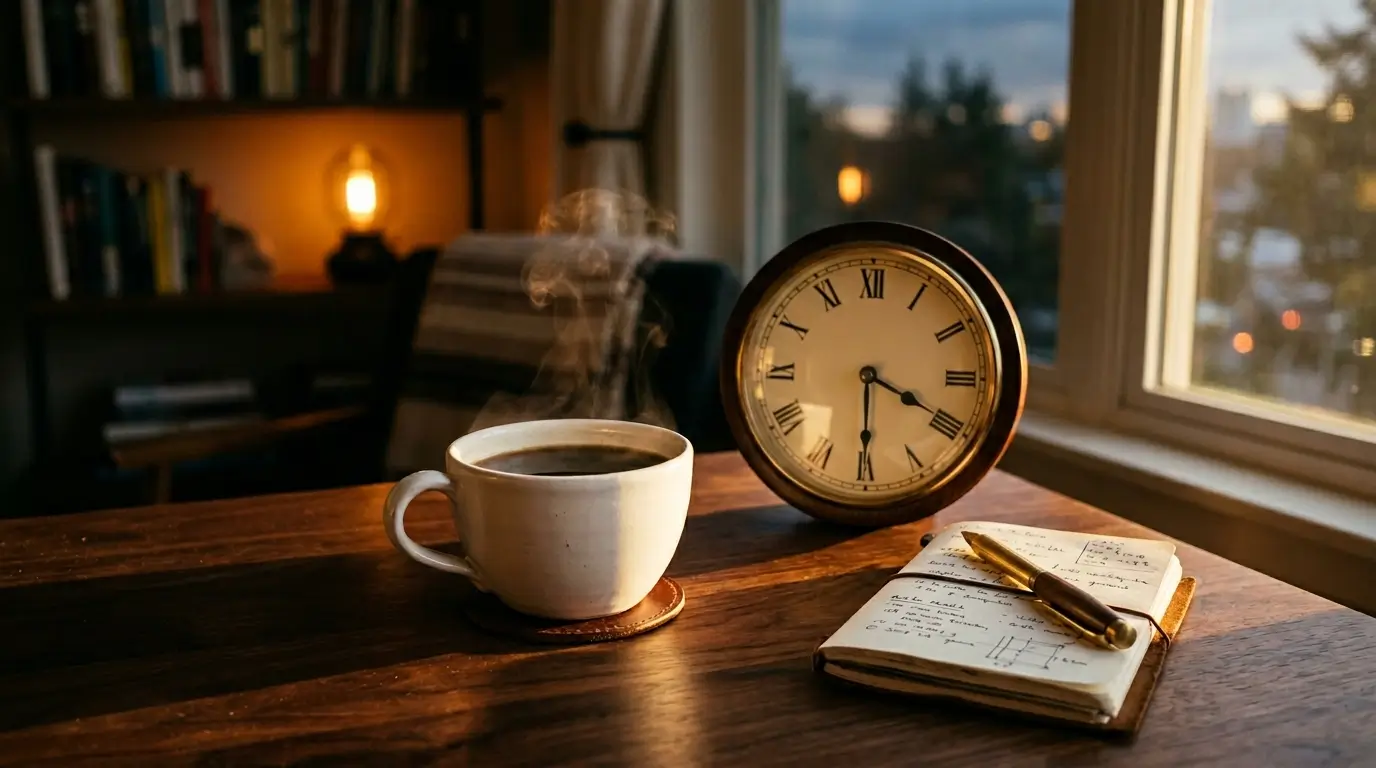
If you have ever wondered why a 4 PM coffee leaves you staring at the ceiling at midnight, the answer is caffeine half-life. Caffeine doesn't just "wear off" once you stop feeling alert. It is still circulating in your bloodstream for hours after the buzz fades, and it directly suppresses the brain chemistry that makes you sleepy.
Below: how caffeine actually exits your body, when to stop drinking coffee for solid sleep, and how to adjust the rule for your own sensitivity.
What Caffeine Half-Life Actually Means
The half-life of caffeine is the time it takes for your body to clear half of what's in your system. For most healthy adults, that figure sits between 4 and 6 hours, with 5 hours as the standard reference.
Half-life is exponential, not linear. After one half-life, half is left. After two, a quarter. After three, an eighth. Here is what 200 mg of caffeine (one Grande Starbucks cold brew) looks like over time:
| Time after drinking | Caffeine still in system |
|---|---|
| 0 hours | 200 mg |
| 5 hours | 100 mg |
| 10 hours | 50 mg |
| 15 hours | 25 mg |
| 20 hours | 12.5 mg |
Swipe to see more →
That residual 50 mg at the 10-hour mark is equivalent to a small cup of green tea still active in your bloodstream when you are trying to sleep.
Why Caffeine Disrupts Sleep Even If You Fall Asleep
Caffeine works by blocking adenosine receptors in the brain. Adenosine is the chemical that builds up during the day and signals "you are tired, go to sleep". When caffeine occupies those receptors, the signal can't land.
Two important consequences:
- You can fall asleep with caffeine in your system, but sleep architecture suffers. Studies show reduced deep (slow-wave) sleep and shorter total sleep time even when subjects don't subjectively notice the disruption.
- 400 mg of caffeine taken 6 hours before bed reduces total sleep by over 1 hour, according to the often-cited Drake et al. (2013) study in the Journal of Clinical Sleep Medicine.
The takeaway: "I can drink coffee at 6 PM and still fall asleep" is technically true and physiologically wrong. You're sacrificing sleep quality without noticing.
The 8-Hour Rule (and Why It's a Floor, Not a Ceiling)
A practical guideline is to stop caffeine at least 8 hours before bed, with 10 hours being safer for sensitive sleepers.
| Bedtime | Latest "safe" caffeine (8h rule) | Conservative cutoff (10h) |
|---|---|---|
| 9:00 PM | 1:00 PM | 11:00 AM |
| 10:00 PM | 2:00 PM | 12:00 PM |
| 11:00 PM | 3:00 PM | 1:00 PM |
| 12:00 AM | 4:00 PM | 2:00 PM |
Swipe to see more →
This is a floor for the average adult, not a guarantee. Your personal half-life depends on:
- Genetics, the CYP1A2 enzyme breaks down caffeine. About half the population are "fast metabolizers"; the other half clear caffeine 30 to 50% slower.
- Pregnancy, caffeine half-life can extend to 10+ hours in the third trimester.
- Oral contraceptives, can roughly double caffeine half-life.
- Liver health, impaired liver function lengthens half-life.
- Smoking, accelerates caffeine clearance (but obviously not a recommended strategy).
- Age, older adults clear caffeine more slowly.
If you take a long time to fall asleep, wake during the night, or feel unrefreshed despite 7+ hours in bed, assume you are a slow metabolizer and shift your cutoff earlier by 2 to 3 hours.
Caffeine Content of Common Drinks
| Drink | Typical caffeine |
|---|---|
| Starbucks Grande Cold Brew (16 oz) | ~205 mg |
| Dunkin Medium Cold Brew (24 oz) | ~260 mg |
| Starbucks Grande Pike Place (16 oz) | ~310 mg |
| Espresso shot (1 oz) | ~75 mg |
| Black tea (8 oz) | ~47 mg |
| Green tea (8 oz) | ~28 mg |
| Matcha latte (Grande) | ~80 mg |
| Energy drink (8 oz Red Bull) | ~80 mg |
| Decaf coffee (8 oz) | ~2 to 5 mg |
Swipe to see more →
For full per-drink caffeine breakdowns, see our Starbucks Cold Brew vs Dunkin Cold Brew guide and Dunkin matcha drinks guide. For overall daily safety, the FDA's published reference is 400 mg per day for healthy adults.
How to Test Your Personal Cutoff
A simple two-week experiment:
- Week 1: stop caffeine at the 8-hour mark before your bedtime.
- Week 2: stop caffeine at the 10-hour mark.
- Track sleep with any wearable, smartphone alarm, or paper journal: time to fall asleep, total sleep, morning grogginess on a 1 to 10 scale.
If Week 2 produces faster sleep onset, fewer wake-ups, or better morning energy, you are a slower metabolizer and should keep the 10-hour rule.
Strategies If You Want Coffee Later in the Day
If giving up afternoon coffee isn't realistic, these reduce sleep impact:
- Switch to half-caf or decaf after noon. Decaf still has 2 to 5 mg per cup, but that is below the disruption threshold for most people.
- Replace afternoon coffee with green tea. ~28 mg caffeine plus L-theanine produces a calmer alertness.
- Cap total daily caffeine at 300 to 400 mg. Higher daily totals appear to extend half-life over weeks.
- Avoid energy drinks late in the day. They often contain 150 to 300 mg in a single can plus added stimulants like guarana that extend the effective half-life.
When to See a Doctor
If you cannot fall asleep without caffeine being entirely out of your system for 14+ hours, you may have an underlying sleep disorder (insomnia, delayed sleep phase) that caffeine is amplifying but not causing. Talk to a clinician rather than just removing coffee.
Sources & References
- FDA: Caffeine Guidance. Daily caffeine safety reference and metabolism notes
- Drake C. et al. (2013), J Clin Sleep Medicine. Effects of caffeine on sleep at 0, 3, and 6 hours before bed
- Sleep Foundation: Caffeine and Sleep. Independent evidence-based reference
- NIH: Caffeine Pharmacology. Half-life, metabolism, CYP1A2 variation