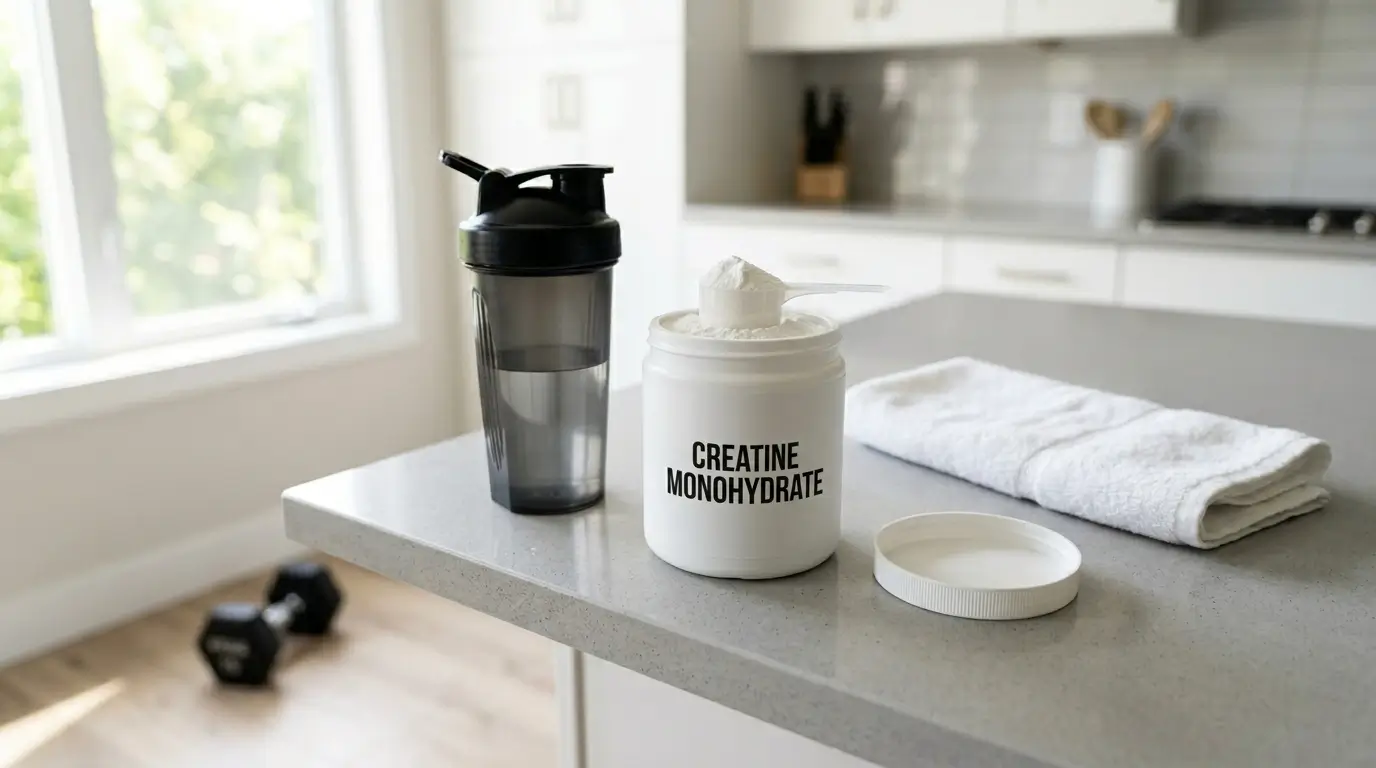
Creatine is the most-studied performance supplement in sports nutrition, and probably the only one with strong evidence behind it for the average gym-goer. Below: what creatine does, how to dose it, when to take it, which form to buy, and what side effects are real vs internet rumor, in plain language for beginners.
What Creatine Actually Does
Your muscles use ATP (adenosine triphosphate) for short, explosive efforts. ATP runs out fast, in seconds. Creatine helps recycle ATP by donating a phosphate group via the phosphocreatine system, which lets you push out 1 to 2 more reps before muscular failure.
The downstream effects in the research:
- Strength: 5 to 15% improvement on heavy lifts over 4 to 12 weeks
- Lean mass: 1 to 4 lb extra muscle gain over a training block (vs placebo)
- Power output: faster sprints, jumps, and high-intensity efforts
- Cognition: emerging evidence for memory and reasoning, especially in sleep-deprived adults and older adults
Creatine is not a stimulant. It does not give you energy in the caffeine sense. It expands the work you can do before fatigue.
Daily Dose: 5 g Is the Answer
The standard maintenance dose is 3 to 5 g per day. Five grams is the most-studied dose and works for almost everyone, regardless of body size.
| Body weight | Suggested daily dose |
|---|---|
| Under 150 lb | 3 g |
| 150 to 200 lb | 5 g |
| Over 200 lb | 5 to 7 g |
Swipe to see more →
A standard scoop from any creatine tub is roughly 5 g. You don't need a precise scale.
Loading: Optional and Often Unnecessary
The "loading phase" (20 g per day for 5 to 7 days, then 5 g maintenance) saturates your muscles faster but doesn't produce a bigger end result.
- With loading: full muscle saturation in ~5 to 7 days
- Without loading (5 g/day): full saturation in ~21 to 28 days
For most beginners, skip loading. The faster saturation isn't worth the GI discomfort some people get from 20 g doses, and 3 weeks at 5 g/day reaches the same endpoint with no risk of stomach upset.
When to Take It (Timing)
Timing barely matters. What matters is taking it every day.
Studies that compare pre- vs post-workout creatine show small or no differences. Studies on rest-day timing show no difference at all. The reason: muscle creatine concentration is determined by chronic intake, not the hour you took it.
Practical advice:
- Pick a time you'll never forget (with morning coffee, with breakfast, in your post-workout shake)
- Skip a day = no problem. Just take 5 g the next day, no need to "make up" the missed dose
- No food required. It absorbs fine on an empty stomach for most people
Which Form to Buy: Monohydrate
The supplement industry sells several creatine variants. Only one has strong evidence:
| Form | Verdict |
|---|---|
| Creatine monohydrate | ✅ Gold standard. 30+ years of research. Cheapest. |
| Creatine HCL | ❌ More expensive, no proven advantage |
| Creatine ethyl ester | ❌ Worse absorption than monohydrate |
| Buffered creatine (Kre-Alkalyn) | ❌ Not better than monohydrate, costs more |
| Liquid creatine | ❌ Degrades in solution; powder is more stable |
Swipe to see more →
Look for micronized creatine monohydrate for slightly better mixability. Check for the Creapure trademark if you want third-party purity testing.
Side Effects: What Is and Isn't Real
What Is Real
- Water retention: 1 to 3 lb in the first 2 to 4 weeks. This is intramuscular water, not bloat. Many people don't notice it.
- GI discomfort at 20 g doses: rare at 5 g, can happen during loading
- Slight increase in serum creatinine on blood tests: not a sign of kidney damage, just a metabolic byproduct your doctor should know about
What Is Not Real
- Kidney damage: in healthy adults with normal kidney function, no evidence of harm in 5+ year studies
- Hair loss: based on a single small study showing increased DHT; not replicated, no follow-up evidence of actual hair loss
- Dehydration / muscle cramps: studies actually show creatine reduces cramp risk, not increases
- Compulsory cycling on/off: no evidence of receptor downregulation; you can take creatine continuously for years
If you have pre-existing kidney disease, talk to a clinician before starting any supplement, including creatine.
Who Benefits Most
- Lifters and strength athletes: largest benefit, most data
- Sprinters, jumpers, court sport athletes: strong benefit for repeated explosive efforts
- Vegetarians and vegans: typically have lower baseline muscle creatine; often see the biggest jump
- Adults over 50: emerging evidence for sarcopenia prevention, cognitive support, fall risk reduction
- Women: same benefits as men, no special "women's creatine" needed despite marketing
Endurance athletes (marathon, ultras) see less direct benefit but still no harm.
Combining Creatine with Protein and Caffeine
- With protein shake: fine. Some old studies suggested caffeine reduces creatine effect; modern research finds the practical effect is minimal.
- With pre-workout caffeine: fine. Take creatine and caffeine together as needed.
- With food: fine. Carbs slightly improve uptake but the difference is small and not worth scheduling around.
For meal-level protein paired with creatine, see how to hit 30g protein without a shake and protein quality score explained.
Cost: One of the Cheapest Effective Supplements
A 1 kg tub of micronized creatine monohydrate runs $25 to $40 USD and lasts roughly 6 to 7 months at 5 g per day. That works out to about $0.15 per day, among the lowest-cost evidence-backed supplements you can buy.
Sources & References
- International Society of Sports Nutrition: Creatine Position Stand (2017). Comprehensive ISSN review on dosing, safety, and efficacy
- Kreider et al. (2017), J Int Soc Sports Nutr. Safety in healthy populations
- Mayo Clinic: Creatine. Independent clinical reference
- NIH Office of Dietary Supplements. Exercise supplement evidence summary