If you're reading this blog, chances are you care about protein but not just the number of grams you eat. You want protein that actually works. Protein that helps your muscles recover, keeps you full and gives you real results.
The tricky part? Not all protein is created equal. Two foods might both have 20 grams of protein, but your body may only use the full benefit from one. Some proteins are easy for your body to digest and absorb, while others barely make a dent.
That's where a Protein Quality Score comes in. It's a simple way to see which proteins your body can truly use and which ones are just taking up space on your plate.
In this guide, we'll explain protein quality, break down high vs low-quality proteins and show how you can make smarter protein choices every day.
What Is Protein Quality?
Protein quality tells you how useful a protein is once you eat it.
When you eat protein, your body breaks it down into amino acids. These amino acids are the building blocks your body uses to:
- Repair muscles after workouts
- Keep you full and satisfied
- Support hormones, enzymes, and overall health
If a protein is missing essential amino acids or is hard to digest, your body won't get the full benefit even if the label says it has "high protein." In that case, it isn't truly a high-quality protein.
What Is a Protein Quality Score?
A Protein Quality Score is a way to measure how "useful" a protein is for your body.
It considers:
- Essential amino acids (especially leucine)
- Digestibility
- How much protein your body can actually absorb and use
This is why 25g of protein from whey is not the same as 25g from a highly processed snack.
Does Protein Quality Matter?
Short answer: Yes.
Protein quality matters if your goal is:
- Building or maintaining muscle
- Fat loss
- Healthy aging
- Faster recovery
- Sustained energy
Low-quality protein:
- Digest poorly
- Lack key amino acids
- Pass through your body with limited benefit
High-quality protein:
- Supports muscle protein synthesis
- Keeps you fuller for longer
- Delivers more value per gram
If you're counting macros but ignoring quality, you're only seeing half the picture. You might be eating enough protein on paper but not getting adequate essential amino acids where it counts.
What Determines Protein Quality?
There are three main factors that determine how high or low a protein scores:
1. Amino Acid Profile
Your body needs 9 essential amino acids from food that it cannot produce on its own. Proteins that supply all of them are considered "complete proteins" and generally rank higher.
Essential Amino Acids:
- Histidine
- Isoleucine
- Leucine (especially important for muscle growth)
- Lysine
- Methionine
- Phenylalanine
- Threonine
- Tryptophan
- Valine
Example:
- Eggs and milk have all essential amino acids → high quality
- Beans alone may lack some → lower quality, but can be paired (like rice + beans) to make a complete protein
2. Protein Digestibility
Digestibility measures how much protein your body can actually absorb.
Example:
- Whey protein digestibility is very high → almost all of it is usable
- Some plant proteins are less digestible → your body uses less due to fiber content and anti-nutrients
3. Bioavailability and Absorption
Even if protein is complete and digestible, your body may not use it efficiently due to:
- Food processing methods
- Anti-nutritional factors (like phytic acid in grains)
- Cooking methods
- Individual digestive health
- Timing of consumption
High-quality proteins have superior bioavailability, meaning more amino acids reach your bloodstream and are available for protein synthesis.
💡 Not sure about your protein sources?
Calculate their quality scores now →
High-Quality vs Low-Quality Protein
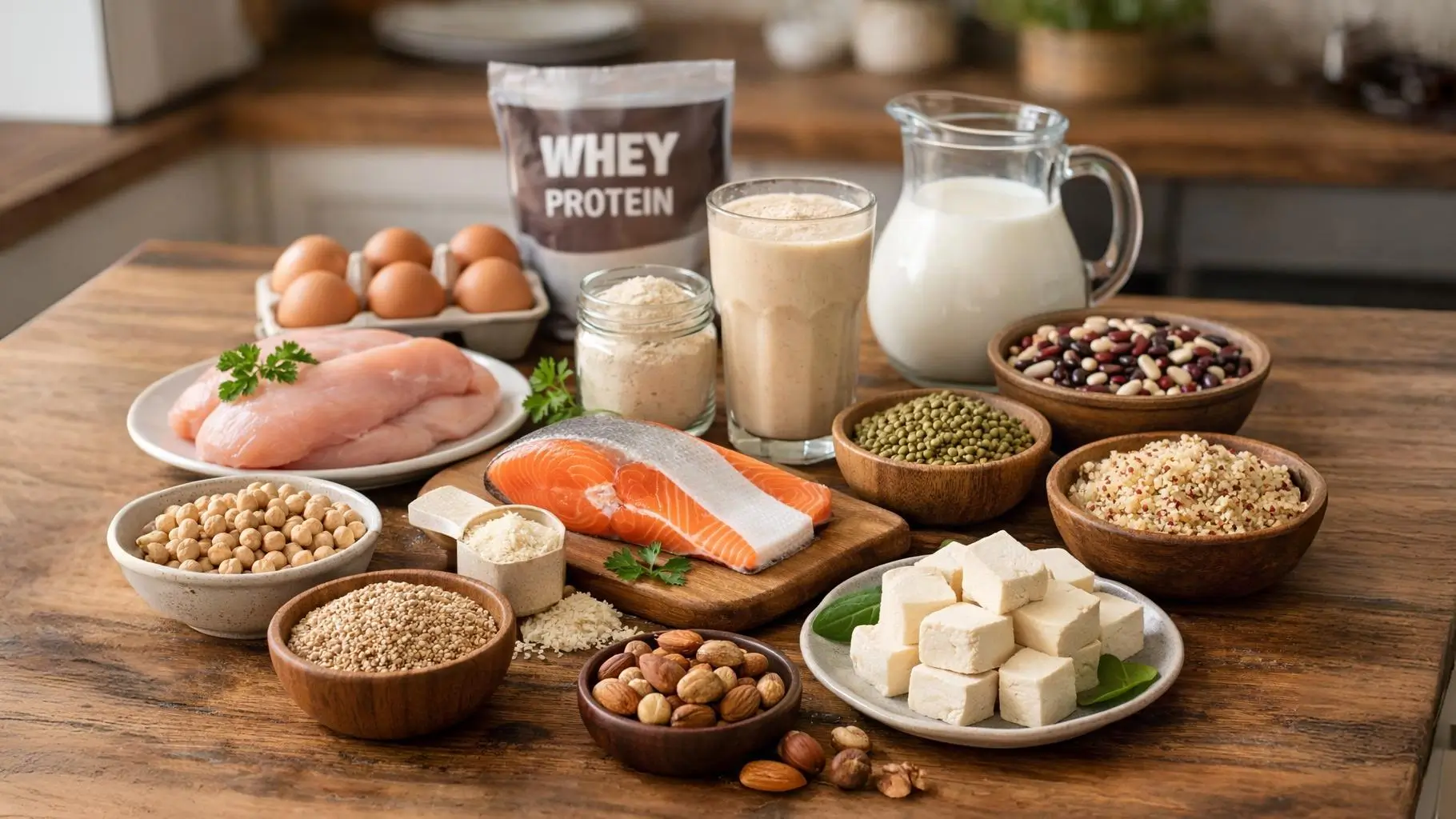
High-quality proteins are complete, easy to digest, and provide all essential amino acids. Examples include:
- Eggs (biological value of 100, the gold standard)
- Milk, yogurt, and cheese (excellent amino acid balance)
- Chicken, turkey, and lean meats (high protein density)
- Fish and seafood (rich in essential amino acids)
- Whey protein powder (rapidly absorbed, high leucine)
- Casein protein (slow-digesting, complete)
- Soy products (tofu, tempeh, edamame - best plant option)
Low-quality proteins may lack some essential amino acids or be harder to digest. Examples:
- Gelatin and collagen peptides (missing tryptophan)
- Some processed protein bars (low protein content, fillers)
- Single-source plant proteins eaten alone (rice, beans individually)
- Wheat gluten (very low lysine)
- Most nuts and seeds alone (low in specific amino acids)
Pro Tip: Combine plant proteins (like rice + beans, or peanut butter + whole wheat bread) to make a complete, high-quality protein meal. This is called protein complementation.
Protein Quality Comparison Table
| Protein Source | Quality Score | Digestibility | Key Features |
|---|---|---|---|
| Whey Protein | Very High | Excellent (95-97%) | Complete protein, rich in leucine, rapidly absorbed |
| Eggs (Whole) | Very High | Excellent (97-98%) | Gold standard for amino acid balance and biological value |
| Milk & Dairy | High | Excellent (95%) | Complete proteins with strong DIAAS scores |
| Chicken & Lean Meat | High | High (94%) | Complete protein with high bioavailability |
| Fish & Seafood | High | High (94-96%) | Easily digestible and rich in all essential amino acids |
| Soy Protein | Medium–High | Good (91%) | Best plant-based complete protein source |
| Pea Protein | Medium | Moderate (85-88%) | Lacks methionine but improves when blended with rice |
| Beans & Lentils | Low–Medium | Moderate (75-85%) | Incomplete alone; needs pairing with grains for completeness |
| Rice Protein | Low–Medium | Moderate (80%) | Low in lysine; better when combined with pea protein |
| Collagen / Gelatin | Low | High (95%) | Missing tryptophan not suitable for muscle growth |
Swipe to see more →
Protein Digestibility: Why It Matters
Even a protein with all essential amino acids can fall short if your body can't digest it properly.
Example:
- 25 grams of protein from whey → Digestibility: 96% → 23 grams usable by your body
- 25 grams of protein from a lower-quality plant protein → Digestibility: 70% → Only 15 grams usable
This difference explains why protein digestibility is just as important as the total grams of protein you consume. It's not just about eating enough protein it's about eating protein your body can actually use.
PDCAAS & DIAAS: How Protein Quality Is Measured
Scientists use scoring systems to determine protein quality. The two most common are PDCAAS and DIAAS.
PDCAAS (Protein Digestibility Corrected Amino Acid Score)
This is the traditional way scientists "grade" protein quality by checking:
- If it has the right amino acid profile
- How well you digest it (measured through fecal analysis)
Limitations:
- Caps the highest score at 1.0 (100%)
- Makes different high-quality proteins look equal
- Uses fecal digestibility (less accurate)
- Doesn't account for individual amino acid digestibility
Example PDCAAS Scores:
- Eggs → 1.0
- Milk → 1.0
- Whey → 1.0 (but actually superior)
- Soy → 0.97
- Beans → 0.68
All proteins scoring 1.0 appear equal, even though whey is actually superior to many others. This is why the nutrition science community moved toward DIAAS.
DIAAS (Digestible Indispensable Amino Acid Score)
This is the newer, more accurate method that measures:
- Exactly how many nutrients your small intestine absorbs
- Individual amino acid digestibility (not just total protein)
- More accurate ileal digestibility measurements
Advantages:
- No scoring cap can exceed 100%
- Shows true differences between high-quality proteins
- More accurate for determining protein quality
- Measures individual amino acid absorption
- Better reflects true biological value
Example DIAAS Scores:
- Whey protein → 109 - 118 (clearly superior)
- Milk protein → 114 - 122
- Beef → 111 - 112
- Soy protein isolate → 90 - 100
- Pea protein → 64 - 82
DIAAS clearly shows why dairy proteins and animal proteins score higher than plant-based alternatives.
The Food and Agriculture Organization (FAO) and nutrition scientists recommend DIAAS as the preferred method for evaluating protein quality in human nutrition.
How to Pick High-Quality Protein for Your Daily Diet?
Choosing high-quality protein only works if you're also eating the right amount of protein for your body based on your weight, activity level, and goals.
👉 How to Calculate Your Daily Protein Intake
You don't need to memorize PDCAAS or DIAAS numbers. Instead, focus on:
1. Choose Complete Proteins When Possible
Prioritize foods with all nine essential amino acids:
- Animal proteins (meat, fish, eggs, dairy)
- Complete plant proteins (soy, quinoa, hemp seeds, chia seeds)
2. Combine Plant Proteins for Higher Quality
Create complete proteins by pairing complementary sources:
- Rice + Beans (complementary amino acids)
- Peanut butter + Whole wheat bread (complete protein combo)
- Hummus + Pita (beans + grains)
- Lentil soup + Whole grain crackers
- Oatmeal + Almond milk + Hemp seeds
3. Check Digestibility
Consider how easily your body processes protein:
- Choose less processed protein sources
- Cook legumes thoroughly to reduce anti-nutrients
- Consider protein powders with high digestibility scores
- Pay attention to how your body responds to different proteins
4. Use Our Calculator for Easy Comparison
To make it even easier, use our free Protein Quality Score Calculator. Just enter any protein source and instantly see its PDCAAS score, DIAAS rating, and how it compares to other proteins.
Check Your Protein Score Now →
What to Do Next?
Now that you understand protein quality score and why it matters, here's how to apply this knowledge:
Step 1: Assess Your Current Protein Sources
Use our calculator to check the quality of proteins you eat regularly. You might be surprised to learn that some "high protein" foods you rely on have lower quality scores than you thought.
Step 2: Compare Different Options
Not sure whether to choose whey or pea protein? Chicken or beans? Use the calculator to compare multiple proteins side-by-side and see which gives you better nutritional value.
Step 3: Make Smarter Choices
Armed with protein quality scores, you can:
- Get more nutrition from fewer calories
- Support muscle growth more effectively
- Optimize your protein timing around workouts
- Make cost-effective protein choices
- Meet your daily protein requirements more efficiently