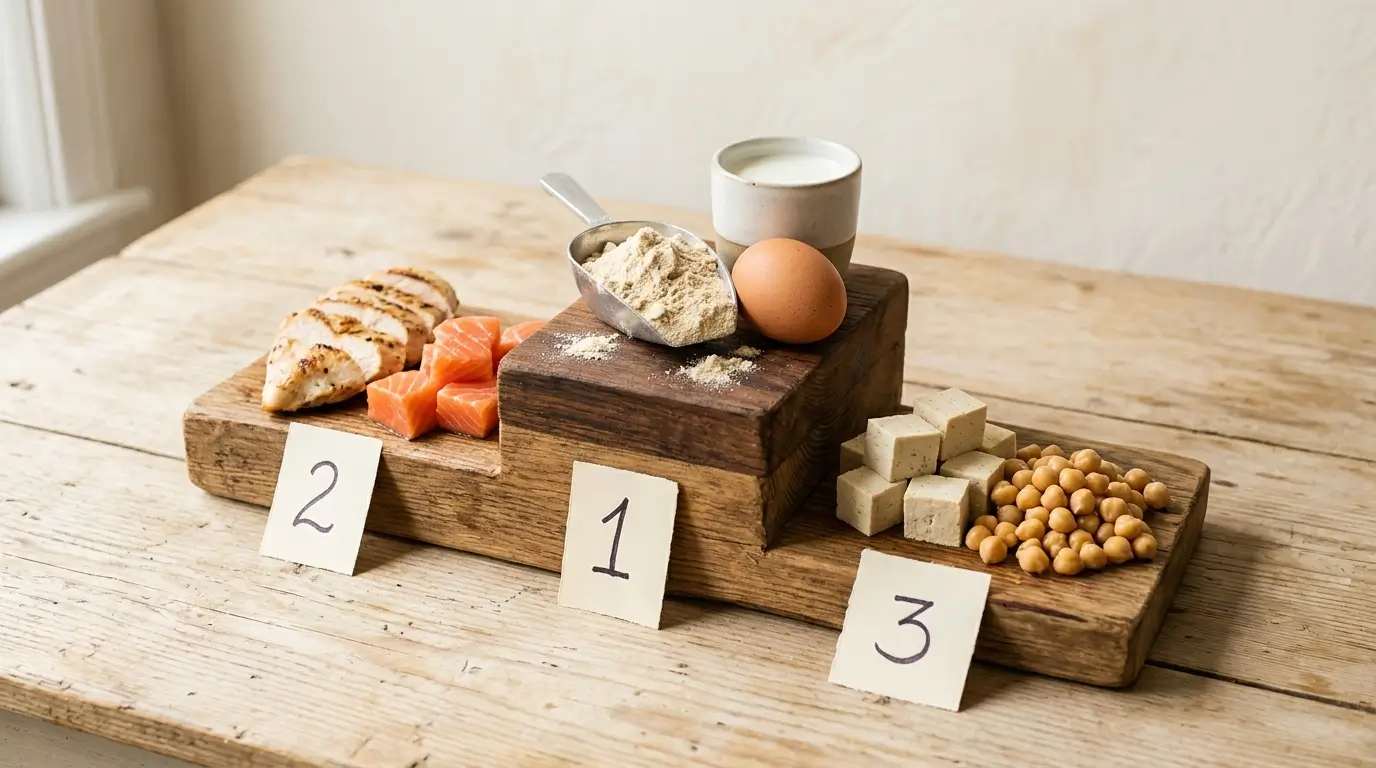
A "complete" protein provides all nine essential amino acids in adequate ratios. Not every protein food qualifies. Most single plant sources are incomplete, while nearly all animal sources are complete.
This guide ranks the best complete protein foods by their DIAAS score (the most accurate measure of protein quality), with notes on protein density per serving, practical cost, and when each one is the right pick.
The Ranking
| Rank | Food | DIAAS | Protein per serving | Notes |
|---|---|---|---|---|
| 1 | Whey protein isolate | 1.09 | 25 g per scoop | Fastest absorption, highest leucine |
| 2 | Milk protein concentrate | 1.18 | 25 g per scoop | Slow + fast blend (casein + whey) |
| 3 | Whole milk | 1.14 | 8 g per cup | Balanced, whole-food source |
| 4 | Whole egg | 1.13 | 6 g per egg | Nature's reference protein |
| 5 | Greek yogurt (plain) | 1.00+ | 17 g per 6 oz | High satiety, probiotic benefit |
| 6 | Beef (lean) | 0.98 | 25 g per 3 oz | Iron, zinc, B12 bonus |
| 7 | Chicken breast | 0.95 | 26 g per 3 oz | Lowest-fat complete protein |
| 8 | Fish (salmon, tuna, cod) | 0.90+ | 20 to 25 g per 3 oz | Omega-3 bonus (fatty fish) |
| 9 | Soy protein isolate | 0.90 | 25 g per scoop | Best plant option |
| 10 | Cottage cheese | 0.89 | 14 g per 1/2 cup | High casein, long-lasting |
| 11 | Quinoa | 0.83 | 8 g per cup cooked | Best complete plant grain |
| 12 | Pea + rice blend (50/50) | 0.82 | 20 to 25 g per scoop | Complete plant blend |
| 13 | Buckwheat | 0.77 | 6 g per cup cooked | Gluten-free complete grain |
Swipe to see more →
Any food scoring 0.75 or higher qualifies as "good to excellent" protein quality per the FAO.
Why Animal Proteins Dominate the Top
Animal proteins evolved in animals that have very similar amino acid needs to humans. Muscle tissue from cows, chickens, fish, and so on naturally matches human amino acid profiles almost perfectly.
The top five animal foods (whey, milk, egg, beef, chicken) all score at or above 0.90 DIAAS and contain adequate amounts of every essential amino acid. They are also rich in leucine, the trigger for muscle protein synthesis, at roughly 8 to 11% of their total protein.
Dairy stands out because it naturally contains both fast-digesting (whey) and slow-digesting (casein) protein fractions. Milk delivers amino acids in a sustained profile over 4 to 6 hours, which is why many athletes use milk or Greek yogurt before bed for overnight muscle support.
The Plant Exceptions
Three plant foods make the complete-protein list on their own:
Soy protein isolate (DIAAS 0.90). The only single plant protein that matches animal sources on amino acid completeness. Slightly low in methionine but still meets adequacy thresholds.
Quinoa (DIAAS 0.83). Rare in the plant world as a complete grain. Higher in protein than rice, wheat, or oats by a meaningful margin (8 g per cup cooked versus 4 to 5 g for other grains).
Buckwheat (DIAAS 0.77). Technically a pseudo-grain (seed of a flowering plant, not a true grass). Naturally gluten-free and complete. Not widely eaten in the U.S. but common in Eastern European and Japanese cuisine.
Other plant foods that qualify as "complete" only in blends:
- Pea + rice (50/50): pea is low in methionine, rice is low in lysine, together they balance.
- Beans + rice: classic complementary pair, produces complete profile.
- Lentils + wheat: another classic combination (hummus on pita, lentil soup with bread).
- Nuts + grains: for example, peanut butter on whole-grain bread.
Remember that you do not need to combine proteins within a single meal. Amino acid balancing happens across the day, so lentil soup for lunch and rice with dinner provides complete protein at the day level.
Protein Density: The Practical Angle
DIAAS ranks quality, but what matters when you are actually eating is protein per calorie and protein per serving. Here is the same list sorted by protein density:
| Food | Protein per 100 cal |
|---|---|
| Chicken breast | 21 g |
| Whey protein isolate | 20 g |
| Lean beef | 17 g |
| Egg whites | 20 g (only) |
| Greek yogurt (nonfat) | 17 g |
| Whole egg | 8 g |
| Salmon | 11 g |
| Milk (1%) | 10 g |
| Quinoa | 4 g |
| Soy protein isolate | 23 g |
Swipe to see more →
Chicken breast and whey isolate are the undisputed leaders for protein density. Soy protein isolate matches them, which is why it is the go-to plant protein for cutting phases. Quinoa and milk are complete but much less dense, so they are better thought of as balanced whole foods rather than protein powerhouses.
Cost per 25 g of Protein
Rough U.S. grocery pricing (2025, varies by region):
| Food | Cost per 25 g protein |
|---|---|
| Dry beans or lentils | $0.20 to $0.30 |
| Whey concentrate powder | $0.60 to $0.90 |
| Chicken thighs | $0.80 to $1.20 |
| Chicken breast | $1.00 to $1.50 |
| Eggs | $0.90 to $1.30 |
| Plain Greek yogurt | $1.00 to $1.50 |
| Canned tuna | $0.80 to $1.30 |
| Lean beef | $2.00 to $3.50 |
| Salmon (fresh) | $3.00 to $5.00 |
| Soy isolate powder | $0.70 to $1.00 |
| Pea + rice blend | $0.80 to $1.20 |
Swipe to see more →
Dry legumes are by far the cheapest complete-when-combined protein source. Whey concentrate and canned tuna are the best-value animal proteins. Fresh salmon is the most expensive per gram but brings omega-3s that no cheaper protein can match.
The "One Best Food" Question
If you could eat only one complete protein food:
- For muscle building on a budget: whey concentrate powder
- For weight loss with highest satiety: plain Greek yogurt
- For whole-food cooking variety: chicken breast
- For nutrition density (not just protein): whole eggs
- For plant-based: soy protein isolate or pea + rice blend
- For overnight recovery: cottage cheese (high casein)
- For omega-3s + protein: salmon
- For convenience: canned tuna or hard-boiled eggs
How Much of Each to Eat
Daily protein targets are:
| Situation | Protein per lb bodyweight |
|---|---|
| Sedentary adult | 0.36 g |
| Active or weight management | 0.6 to 0.8 g |
| Muscle gain or training cut | 0.8 to 1.0 g |
Swipe to see more →
For a 170 lb active adult aiming for 0.8 g per lb (136 g protein per day), typical food combinations:
- Breakfast: 2 eggs + 1 cup Greek yogurt = 28 g
- Lunch: 6 oz chicken breast + 1/2 cup beans = 55 g
- Snack: 1 scoop whey = 25 g
- Dinner: 6 oz salmon + 1/2 cup quinoa = 40 g
Total: 148 g, well over target. Hitting daily protein is not hard once you know what foods deliver.
Calculate Your Protein Target
Use the DrinkDigits Macro Calculator to get your personal daily protein goal based on body weight, activity, and whether you are cutting, maintaining, or bulking. For a deeper look at protein quality scoring, see our what is protein quality score guide, or the PDCAAS vs DIAAS comparison for the scientific background.
Sources & References
- FAO: Dietary Protein Quality Evaluation (DIAAS report, 2013). DIAAS scores for all foods listed.
- USDA FoodData Central. Per-serving protein and amino acid data.
- Rutherfurd SM et al., J Nutr (2015). PDCAAS and DIAAS comparison study.
- NIH Office of Dietary Supplements: Protein. Daily protein recommendations.
- International Society of Sports Nutrition: Protein Position Stand. Protein guidance for active adults.