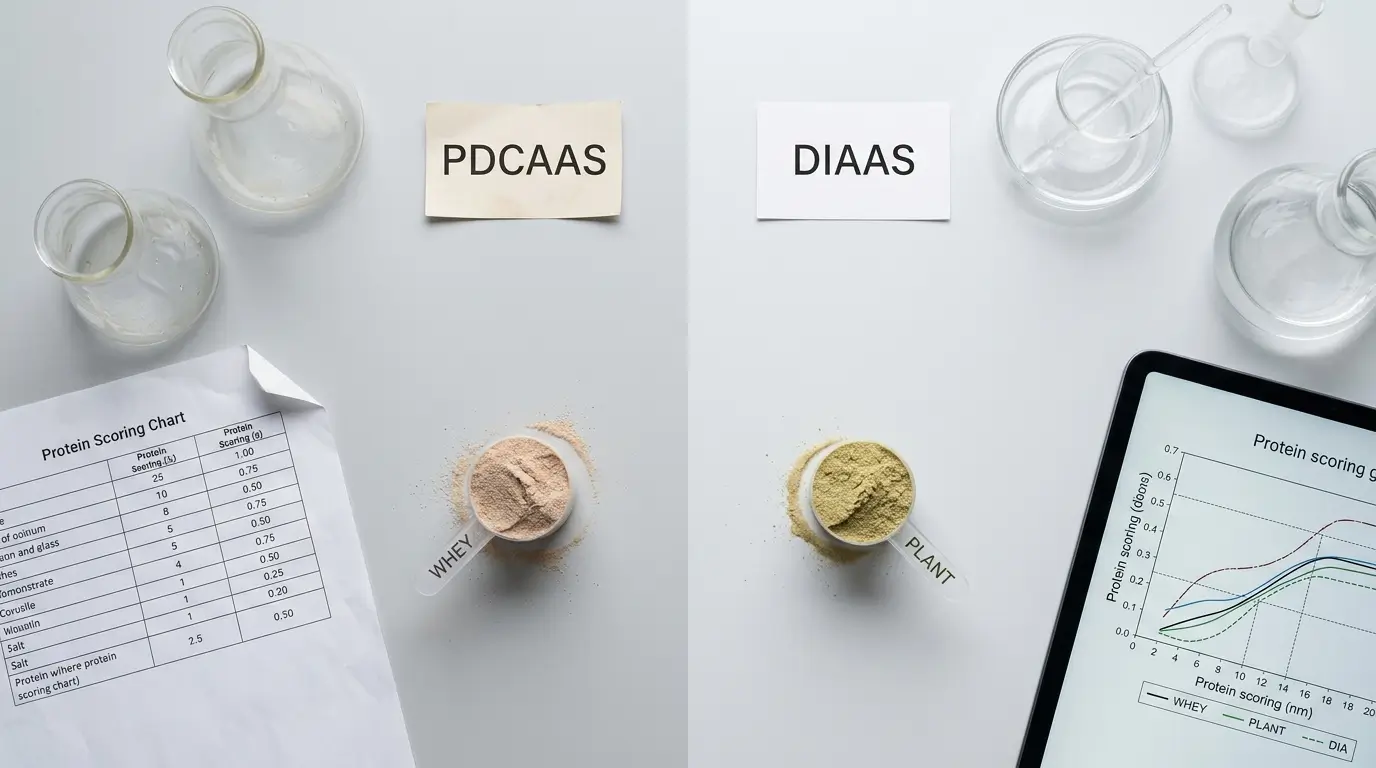
Not all protein is equal. A gram of whey and a gram of wheat protein both show "1 g protein" on a nutrition label, but your body uses them very differently. Protein quality scores exist to capture that difference.
The two scoring systems you will see are PDCAAS (Protein Digestibility Corrected Amino Acid Score), used since 1991, and DIAAS (Digestible Indispensable Amino Acid Score), formally recommended by the FAO in 2013 to replace PDCAAS.
DIAAS is more accurate. PDCAAS is still more common on labels. Here is what each measures, why DIAAS is better, and which one to use when comparing protein sources.
The Short Answer
PDCAAS measures whether a protein provides all essential amino acids in adequate ratios, corrected for fecal digestibility, and capped at 1.0. A score of 1.0 means "meets all needs."
DIAAS measures the same thing with two improvements: it uses ileal digestibility (measured at the small intestine, which is more biologically relevant than fecal), and it is not capped at 1.0, so high-quality proteins can score above 100.
For ranking and comparing proteins, DIAAS is more useful. For regulatory labels in most countries including the U.S., PDCAAS is still the standard.
What PDCAAS Measures
PDCAAS was introduced by the FAO/WHO in 1991 and remains the most common reference on supplement labels. Three inputs go into the score:
- Amino acid profile. Is each of the nine essential amino acids present in adequate amounts relative to a human reference pattern (originally the needs of a 2 to 5-year-old child)?
- Limiting amino acid. The amino acid present in the lowest amount relative to the reference dictates the score. If lysine is at 70% of the reference and everything else is at 120%, the score is capped by the lysine.
- Digestibility correction. How much of the protein is actually absorbed? PDCAAS uses fecal digestibility: protein measured in stool compared to intake.
The final number is then capped at 1.0. Any protein that would score above 1.0 (milk, whey, egg, beef) is truncated to 1.0 in the official PDCAAS listing.
Example PDCAAS scores:
| Protein source | PDCAAS |
|---|---|
| Whey protein isolate | 1.0 (truncated; actual ~1.15) |
| Casein | 1.0 (truncated) |
| Egg white | 1.0 |
| Milk protein | 1.0 |
| Beef | 0.92 |
| Soy protein isolate | 1.0 |
| Pea protein | 0.73 |
| Wheat gluten | 0.25 |
| Rice protein | 0.47 |
Swipe to see more →
Why PDCAAS Has Limitations
Three specific criticisms drove the move to DIAAS:
The 1.0 cap distorts comparisons. Whey and egg are meaningfully higher quality than the "1.0" label suggests. Capping the score makes all "complete" proteins look equal, which is not accurate.
Fecal digestibility is the wrong endpoint. Protein is absorbed in the small intestine. After that, gut bacteria in the large intestine modify and consume some of what remains. Measuring in stool captures what is left after bacterial activity, not what your body actually absorbed. Ileal digestibility (measured at the end of the small intestine) is more biologically accurate.
Antinutrients are not fully accounted for. Many plant proteins contain compounds that reduce amino acid absorption (phytates, tannins, trypsin inhibitors). PDCAAS corrects for digestibility but not always for these specific inhibitors.
What DIAAS Fixes
DIAAS was introduced by the FAO in 2013 to address all three issues.
Ileal digestibility instead of fecal. DIAAS uses amino acid levels measured at the end of the small intestine, typically in animal model studies or human studies with ileal cannulation. This is a more accurate measure of what the body actually absorbs.
Individual amino acid scoring. Instead of correcting whole-protein digestibility at the end, DIAAS calculates the score for each individual essential amino acid based on its specific ileal digestibility, then uses the lowest value.
Not capped at 1.0. DIAAS scores above 100 are allowed, which means high-quality proteins score accurately relative to each other.
Example DIAAS scores:
| Protein source | DIAAS | Category |
|---|---|---|
| Whey protein concentrate | 1.09 | Excellent |
| Milk protein concentrate | 1.18 | Excellent |
| Whole milk | 1.14 | Excellent |
| Whole egg | 1.13 | Excellent |
| Beef | 0.98 | Excellent |
| Soy protein isolate | 0.90 | Good |
| Pea protein concentrate | 0.82 | Good |
| Rice protein concentrate | 0.37 | Low |
| Wheat flour | 0.45 | Low |
Swipe to see more →
The FAO categorizes DIAAS scores:
- 0.75 or below: low protein quality
- 0.76 to 1.00: good protein quality
- Above 1.00: excellent protein quality
PDCAAS vs DIAAS Side by Side
Same proteins, both scoring systems:
| Protein | PDCAAS | DIAAS |
|---|---|---|
| Whey isolate | 1.00 | ~1.09 |
| Milk protein | 1.00 | 1.18 |
| Whole egg | 1.00 | 1.13 |
| Beef | 0.92 | 0.98 |
| Soy protein isolate | 1.00 | 0.90 |
| Pea protein | 0.73 | 0.82 |
| Rice protein | 0.47 | 0.37 |
Swipe to see more →
Notice that soy protein drops from 1.00 (PDCAAS) to 0.90 (DIAAS) and pea protein rises from 0.73 to 0.82. DIAAS gives a more granular and accurate picture of plant proteins specifically, partly because it accounts better for antinutrient effects.
Which Score Should You Use?
For most purposes, DIAAS is the better reference if you can find it. It is published in research papers and some newer product spec sheets.
In practice, DIAAS is not yet universal on consumer labels. Most U.S. supplement labels still show PDCAAS or "amino acid profile" as the closest equivalent. So for casual comparison while shopping, PDCAAS remains the dominant number you will encounter.
The practical rule: treat any protein with PDCAAS 1.0 as "complete." For higher-resolution comparison between complete proteins (whey vs egg vs milk), consult DIAAS tables from FAO or peer-reviewed research.
When Protein Quality Matters Most
Quality matters more in these scenarios:
Plant-based diets. Most single plant proteins are incomplete or low-quality by themselves. Combining sources (pea + rice, or whole foods like lentils + rice) creates a complete profile. Our plant protein vs whey guide covers combinations in detail.
Lower total protein intake. If you are eating only 40 to 60 g of protein per day, quality matters a lot because every gram has to count. At 150+ g per day (common for active adults), quality matters less because even lower-quality proteins combine to meet all amino acid needs.
Specific populations. Young children, older adults with sarcopenia, and people recovering from illness or surgery benefit most from high-quality proteins.
For athletes hitting 1.0+ g per lb, protein quality is less critical because total volume ensures amino acid needs are met regardless of source mix.
How to Use a Protein Quality Score Calculator
The DrinkDigits Protein Quality Score Checker lets you input a protein source and see its relative quality score. For a foundational overview of protein quality, see our what is protein quality score guide. For how to calculate your personal daily protein target, use the DrinkDigits Macro Calculator.
Summary
PDCAAS has been the standard since 1991 but has three known flaws: the 1.0 cap, fecal-based digestibility, and insufficient handling of antinutrients. DIAAS (2013) fixed all three. DIAAS is more accurate, especially when comparing plant proteins or ranking high-quality sources. PDCAAS is still what you will see on most U.S. supplement labels.
Both scores agree on the big picture: animal proteins (whey, milk, egg, beef) are the highest quality. Soy is the strongest single plant protein. Pea and rice combinations produce complete profiles. Wheat and corn proteins alone are low quality and should be combined with other sources.
Sources & References
- FAO/WHO: Dietary Protein Quality Evaluation (PDCAAS report, 1991). Original PDCAAS methodology.
- FAO: Dietary Protein Quality Evaluation in Human Nutrition (DIAAS report, 2013). DIAAS methodology and published scores.
- Rutherfurd SM et al., J Nutr (2015). Comparing PDCAAS and DIAAS for common protein sources.
- USDA FoodData Central. Amino acid composition data for common foods.
- NIH Office of Dietary Supplements: Protein. Government reference for daily protein recommendations.