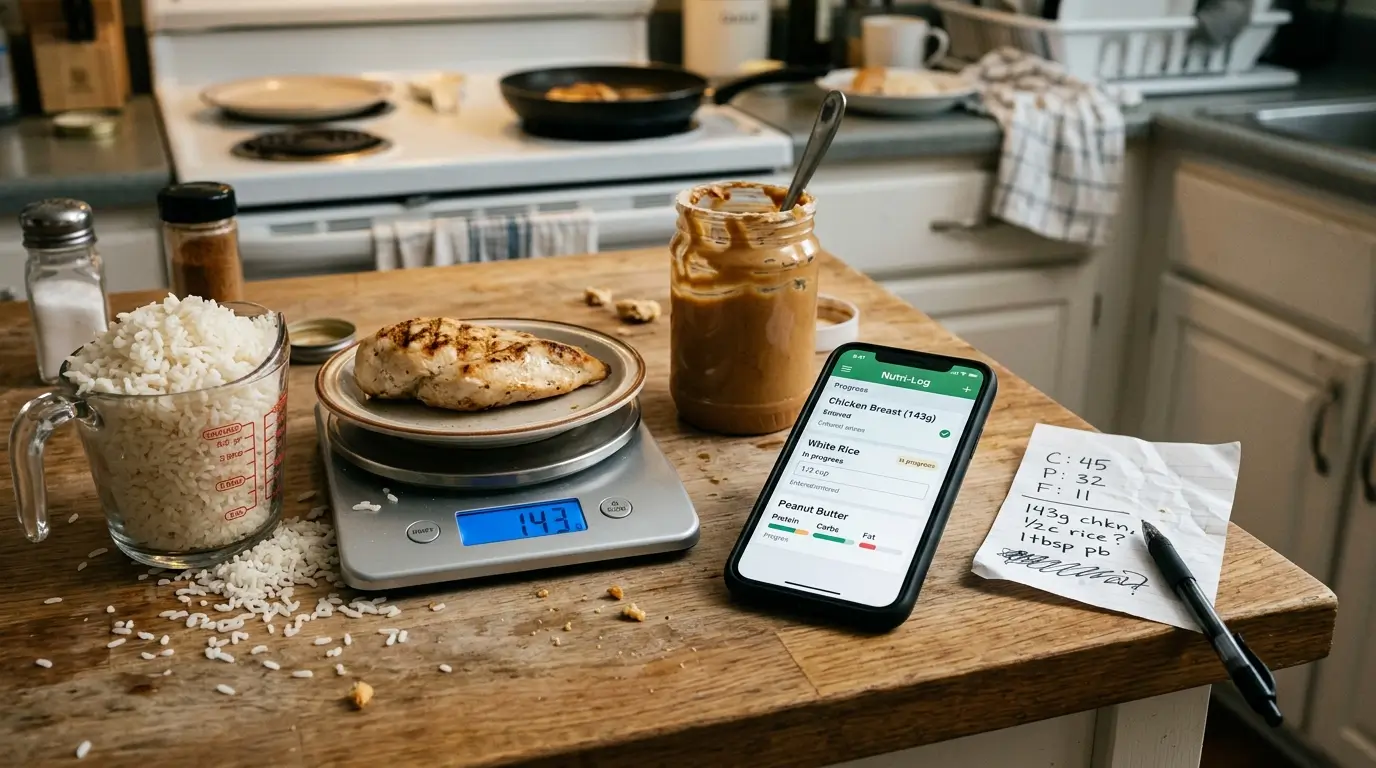
Most people who give up on macro tracking do not give up because it is too hard. They give up because the results do not match the effort. Weeks of careful logging and no weight change. Always feeling hungry. Feeling like the numbers are lying.
The numbers are not lying. The inputs are wrong. Almost every stalled tracking attempt comes down to the same handful of mistakes, and all of them are fixable once you know what to look for.
1. Eyeballing Portions
The single biggest mistake is estimating portion sizes by eye. Studies consistently show that people underreport food intake by 20 to 40%. A "medium" apple might be 150 g or 220 g, a difference of about 40 calories. That does not sound like much until you realize it happens five times a day, every day.
The fix is to weigh food on a kitchen scale for two weeks. Not forever, just long enough to calibrate your eye. You will learn what 40 g of oats actually looks like, what 100 g of chicken breast looks like cooked, and how much 15 g of peanut butter is (spoiler: less than you think). After two weeks most people can eyeball with 10 to 15% accuracy, which is good enough for everyday tracking.
2. Ignoring Cooking Oils and Condiments
Olive oil is 120 calories per tablespoon. A "drizzle" over your salad is easily two tablespoons. Mayo, ranch, tahini, and peanut butter are all 90 to 100 calories per tablespoon. Most people log their chicken and rice but forget the tablespoon of oil they cooked it in, which is 120 untracked calories.
Track oils and condiments by volume or weight. Use a teaspoon or tablespoon, not a pour. Or measure the whole container's worth upfront, divide by portions, and log a fixed amount per meal.
3. Logging "Grilled Chicken Breast" Without Specifying Cooked vs Raw
Raw and cooked weights are very different. A 6 oz raw chicken breast cooks down to about 4.5 oz, a 25% reduction from water loss. If you log "6 oz chicken breast, cooked" but meant the raw weight, you just underreported your meal by 50 calories and 10 g of protein.
Most food databases default to cooked weight for meat. Weigh meat after cooking, or convert raw to cooked using a 0.75 factor as a rough rule.
4. Underestimating Liquid Calories
A "latte" is not a calorie. It is 120 to 280 calories depending on size, milk, and syrups. A "smoothie" can be anywhere from 200 to 700. A glass of wine is 120 to 150.
Coffee-shop drinks are particularly sneaky because the size and customization vary so much. A Grande vanilla latte with 2% milk is 250 calories. Switch to oat milk and it jumps to 270. Add caramel drizzle, 300. See our Starbucks Calorie Calculator or Dunkin Calorie Calculator for exact numbers on any customization.
The fix is simple: log every calorie that has calories. Water, plain tea, and black coffee are free. Everything else goes in the tracker.
5. Free-Text Logging Instead of Scanning Barcodes
Apps like MyFitnessPal, Cronometer, and MacroFactor all have barcode scanners that pull verified nutrition data. Typing "banana" pulls whatever entry is at the top of a user-submitted list, which is often wrong by 20 to 30 calories.
Scan barcodes for packaged foods. For whole foods, use the USDA FoodData Central entries, which are verified. Avoid user-submitted entries when you have a choice.
6. Hitting Protein Perfectly but Overshooting Carbs or Fat
Protein has a clear target and a hard minimum. Carbs and fat are often treated as a budget, but many people only hit the carb budget and consistently overshoot fat (9 calories per gram adds up fast).
If your carb and fat targets are off by 10 g each in the wrong direction, that is an extra 130 calories a day. Over a week, 900 extra calories. Enough to erase your entire weekly deficit.
Track all three macros, not just protein. Set a hard ceiling on fat in particular because it is calorie-dense.
7. Not Adjusting After 2 to 3 Weeks
Calculated TDEE is an estimate with 10 to 15% margin. If you set targets from a calculator and never adjust, you might be eating 200 calories above or below your actual maintenance. Either you will lose nothing or lose faster than you want.
Weigh yourself weekly at the same time of day, fasted. After 2 to 3 weeks, if you are losing 0.5 to 1% bodyweight per week, stay the course. If not, adjust carbs by 100 to 150 calories in the appropriate direction. This is the whole "adjustment" process.
8. Drinking Alcohol Without Budgeting for It
Alcohol has 7 calories per gram, more than protein or carbs. A pint of beer is 150 to 200 calories. A margarita is 250 to 500. A glass of wine is 120 to 150. Two drinks on a Saturday night can easily be 400 to 600 calories, which is a substantial chunk of a weekly deficit.
You do not have to quit drinking. But you do have to log it like any other calorie source.
9. Weekend Drift
Five days of tight tracking followed by two days of eyeballing is a common pattern that erases most of the week's deficit. "I was good all week" plus 2,000 extra calories on Saturday and Sunday equals zero progress, because the math does not care which days the calories happened on.
Track weekends the same as weekdays. If you want a looser weekend, bank calories during the week by eating slightly below target, then spend them Friday and Saturday. The weekly average is what matters.
10. Obsessing Over the Decimal Points
The opposite problem is being so precise that tracking becomes a chore. If your target is 135 g protein and you hit 131 g, that is fine. Plus or minus 10% on each macro target is close enough.
Aim for consistency over perfection. Someone who hits 85% of their target every day for 12 weeks will out-progress someone who hits 100% for 3 weeks and then quits.
When Tracking Should Stop
Tracking is a tool, not a lifestyle. After 3 to 6 months of consistent tracking, most people internalize portion sizes and macro patterns well enough to maintain without logging. If tracking is causing food anxiety, sleep disruption, or social avoidance, it is time to take a break and reassess. See our macros explained guide for the underlying logic of macros without the daily grind.
Mistake → Fix Quick Reference
| Mistake | Fix | Typical calorie impact |
|---|---|---|
| Eyeballing portions | Weigh for 2 weeks to calibrate | 200 to 400 cal/day undercounted |
| Ignoring cooking oil | Measure tbsp or tsp | 120 cal per unlogged tablespoon |
| Logging raw meat as cooked | Weigh cooked, or use 0.75 conversion | 50 to 80 cal per meal error |
| Missing liquid calories | Log every drink with calories | 200 to 500 cal/day undercounted |
| User-submitted database entries | Use scanner for barcoded foods, USDA for whole foods | 20 to 40 cal per entry drift |
| Hitting protein only | Track all 3 macros with hard fat ceiling | 100+ cal/day overshoot on fat |
| Never adjusting calories | Re-check every 2 to 3 weeks | Stalled progress |
| Not logging alcohol | Log drinks like any other calorie source | 400 to 600 cal per night out |
| Weekend "free days" | Track weekends the same as weekdays | Full weekly deficit erased |
| Perfectionism paralysis | Aim for ±10% of target, not 100% | Burnout and quitting |
Swipe to see more →
Quick Checklist Before You Blame Your Metabolism
Before concluding that your body is "broken" or "different," check whether you are:
- Weighing portions, not eyeballing
- Logging oils and condiments
- Specifying cooked weights
- Tracking liquid calories
- Using verified (scanned) database entries
- Tracking all three macros
- Adjusting targets based on actual progress
- Logging alcohol
- Tracking weekends the same as weekdays
Fix any of those and your tracking will suddenly start matching reality. Combine with the DrinkDigits Macro Calculator to reset your targets if you suspect your original numbers are off.
Sources & References
- NIH: Underreporting of Dietary Intake. Studies showing 20 to 40% underreporting in self-reported food logs.
- USDA FoodData Central. Verified food database, more accurate than user-submitted entries.
- Mayo Clinic: Calorie Counting. Practical calorie-tracking guidance.
- Academy of Nutrition and Dietetics. Registered dietitian guidance on macro and calorie tracking.