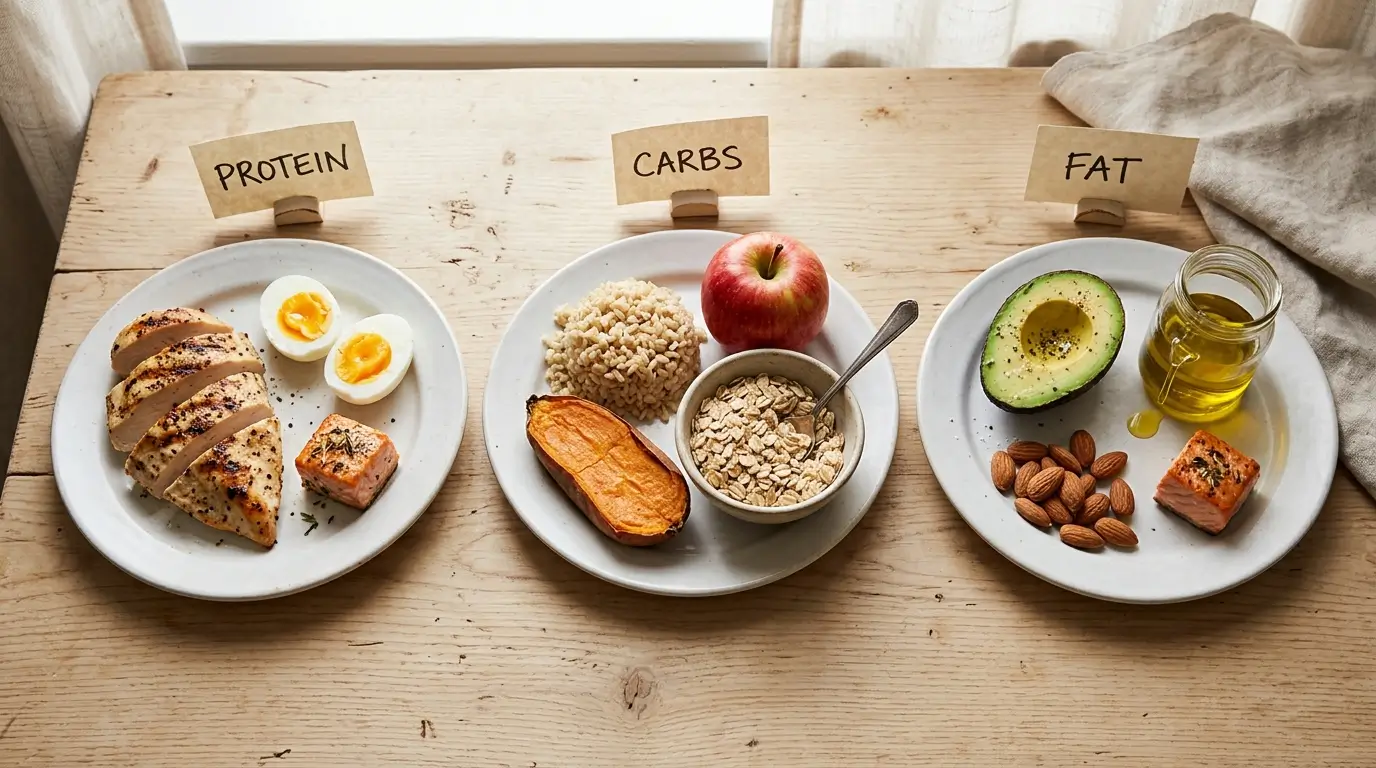
"Macros" is short for macronutrients, the three nutrients that provide the calories in your food: protein, carbohydrates, and fat. Understanding how they work is the foundation of almost every effective nutrition plan, from weight loss to muscle gain to blood sugar management.
Below: what each macro does, how many calories each provides, how they interact, what typical ratios look like for different goals, and how to read them on a nutrition label. Once you have the basics down, use the DrinkDigits Macro Calculator to get your personal targets.
The Three Macronutrients at a Glance
| Macro | Calories per gram | Main role |
|---|---|---|
| Protein | 4 | Build and repair tissue, preserve muscle |
| Carbohydrates | 4 | Primary fuel, especially for brain and workouts |
| Fat | 9 | Long-term energy, hormone production, vitamin absorption |
Swipe to see more →
Alcohol also has calories (7 per gram), but it is not a macronutrient because the body does not use it for structure or regulation.
1. Protein: The Building Block
Protein is made of amino acids, which your body uses to build and repair everything from muscle fibers to enzymes, antibodies, and hair. Nine of the 20 amino acids are called "essential" because your body cannot make them. You have to eat them.
What protein does:
- Repairs and builds muscle after workouts
- Preserves lean mass when you are in a calorie deficit
- Keeps you full longer than carbs or fat (the highest satiety per calorie)
- Supports your immune system and hormone production
How much you need, based on NIH and sports nutrition guidance:
| Situation | Protein target (per day) |
|---|---|
| Sedentary adult | 0.36 g per lb (RDA minimum) |
| Active or weight management | 0.6 to 0.8 g per lb |
| Muscle gain or cutting while training | 0.8 to 1.0 g per lb |
| Older adults (sarcopenia prevention) | 0.5 to 0.7 g per lb |
Swipe to see more →
Common sources: chicken breast, eggs, Greek yogurt, lean beef, fish, tofu, lentils, whey and plant-based protein powders. Not all protein is equal in quality, as covered in our Protein Quality Score guide.
2. Carbohydrates: Your Body's Preferred Fuel
Carbs get villainized by low-carb and keto marketing, but they are the body's preferred energy source, especially for the brain and high-intensity training. Your brain alone uses about 120 g of glucose per day.
What carbs do:
- Provide quick and sustained energy
- Fuel high-intensity exercise like weight training and sprinting
- Replenish muscle glycogen after workouts
- Provide fiber, which supports digestion and blood sugar stability
Types of carbs:
- Simple carbs: sugars in fruit, candy, soda, honey. Fast energy and can spike blood sugar.
- Complex carbs: starches in rice, oats, potatoes, bread. Slower release.
- Fiber: technically a carb your body does not fully digest. It slows absorption and supports gut health. Aim for 25 to 38 g per day.
Carbs are typically the adjustable macro: whatever calories remain after you have set protein and fat. Typical ranges as a percent of calories:
| Diet style | Carb % of calories |
|---|---|
| Low-carb or keto | 5 to 20% |
| Moderate or balanced | 40 to 55% |
| High-carb (endurance athletes) | 55 to 70% |
Swipe to see more →
Common sources: rice, oats, potatoes, fruit, whole-grain bread, pasta, legumes, vegetables.
3. Fat: Essential, Not Evil
Fat is calorie-dense (9 cal/g versus 4 for protein and carbs), which is why low-fat diets used to be the default. But fat is essential. You literally need it to absorb fat-soluble vitamins (A, D, E, K) and to produce hormones including testosterone and estrogen.
What fat does:
- Produces steroid hormones
- Absorbs fat-soluble vitamins
- Cushions organs and insulates nerves
- Provides long-lasting energy at rest and low-intensity exercise
Types of fat:
- Monounsaturated (MUFA): olive oil, avocado, nuts. Generally heart-healthy.
- Polyunsaturated (PUFA): fish oil, walnuts, flaxseed. Includes essential omega-3s.
- Saturated: butter, cheese, fatty meat, coconut oil. Fine in moderation. The AHA recommends under about 13 g per day.
- Trans fats: industrial partially-hydrogenated oils. Avoid. The FDA has largely banned them but trace amounts exist.
A minimum of about 0.3 to 0.4 g per lb bodyweight supports basic hormone function. Most healthy diets range from 20 to 40% of total calories from fat.
Common sources: olive oil, avocado, nuts and seeds, fatty fish, egg yolks, cheese, butter.
Macro Ratios for Common Goals
These are starting points, not absolutes. Individual response varies.
| Goal | Protein | Carbs | Fat |
|---|---|---|---|
| Weight loss (moderate deficit) | 30 to 35% | 35 to 45% | 25 to 30% |
| Muscle gain (slight surplus) | 25 to 30% | 45 to 55% | 20 to 25% |
| Maintenance or recomposition | 25 to 30% | 40 to 50% | 25 to 30% |
| Low-carb or keto | 20 to 25% | 5 to 10% | 65 to 75% |
| Endurance training | 15 to 20% | 55 to 65% | 20 to 25% |
Swipe to see more →
Worked Example: 2,000-Calorie Day for Moderate Weight Loss
Target macros: 32% protein, 38% carbs, 30% fat.
| Macro | Calories | Grams |
|---|---|---|
| Protein (32%) | 640 | 160 g (640 ÷ 4) |
| Carbs (38%) | 760 | 190 g (760 ÷ 4) |
| Fat (30%) | 600 | 67 g (600 ÷ 9) |
Swipe to see more →
A full day might look like: two eggs and oatmeal with berries for breakfast, grilled chicken salad with olive oil for lunch, a high-protein Starbucks drink as a snack, salmon with rice and vegetables for dinner, and cottage cheese with nuts in the evening.
How Calories and Macros Relate
Calories = (grams of protein × 4) + (grams of carbs × 4) + (grams of fat × 9)
That is it. No other hidden math. Every calorie in your food comes from one of these three macros, or from alcohol if present.
This is why calorie counts and macro counts must add up. If a food label says 200 calories, 20 g protein, 10 g carbs, 5 g fat, the math is (20×4) + (10×4) + (5×9) = 165 calories. The extra 35 usually comes from rounding or from fiber that manufacturers count differently.
Reading Macros on a Nutrition Label
U.S. Nutrition Facts labels list macros in grams, per serving:
- Total Fat (sometimes broken into saturated, trans, polyunsaturated, monounsaturated)
- Total Carbohydrate (broken into dietary fiber, total sugars, added sugars)
- Protein
Two things to watch. First, serving size: if the label says 200 cal but there are 2.5 servings per container, the whole package is 500 cal. Second, added sugars: the AHA recommends under 25 g per day for women and 36 g for men. Many café drinks exceed that daily limit in a single serving.
Common Macro Mistakes
Only tracking protein while ignoring fat and carbs often means hitting protein targets but blowing total calories. Assuming "low fat" equals healthy ignores that low-fat processed foods often replace fat with added sugar. Fearing carbs is unnecessary if they fit your total calorie and nutrient needs. Ignoring fiber leads to low satiety and worse blood sugar response. And chasing perfect round-number targets every day is near-impossible; aim for plus or minus 10% of each target instead.
Tools to Track Your Macros
The DrinkDigits Macro Calculator calculates your personal targets based on body weight, activity, and goal. For café drinks, the Starbucks Calorie Calculator and Dunkin Calorie Calculator check macros of customized orders before you buy. For daily food logging, apps like MyFitnessPal, Cronometer, and MacroFactor work well.
Summary
Macros are not complicated. Protein builds and repairs, carbs fuel, fat supports hormones and absorption. All three have 4 to 9 calories per gram and they add up to your total calorie intake. Once you know your personal targets, the rest is just consistent tracking.
Start with the Macro Calculator to get your numbers, then read how to calculate macros for weight loss or how to calculate daily protein intake for the next steps.
Sources & References
- NIH Office of Dietary Supplements: Protein. Protein recommendations and functions.
- USDA Dietary Guidelines for Americans, 2020 to 2025. Macronutrient distribution ranges (AMDR).
- American Heart Association: Fats and Oils. Saturated fat recommendations.
- International Society of Sports Nutrition: Protein and Exercise. Protein for active adults.