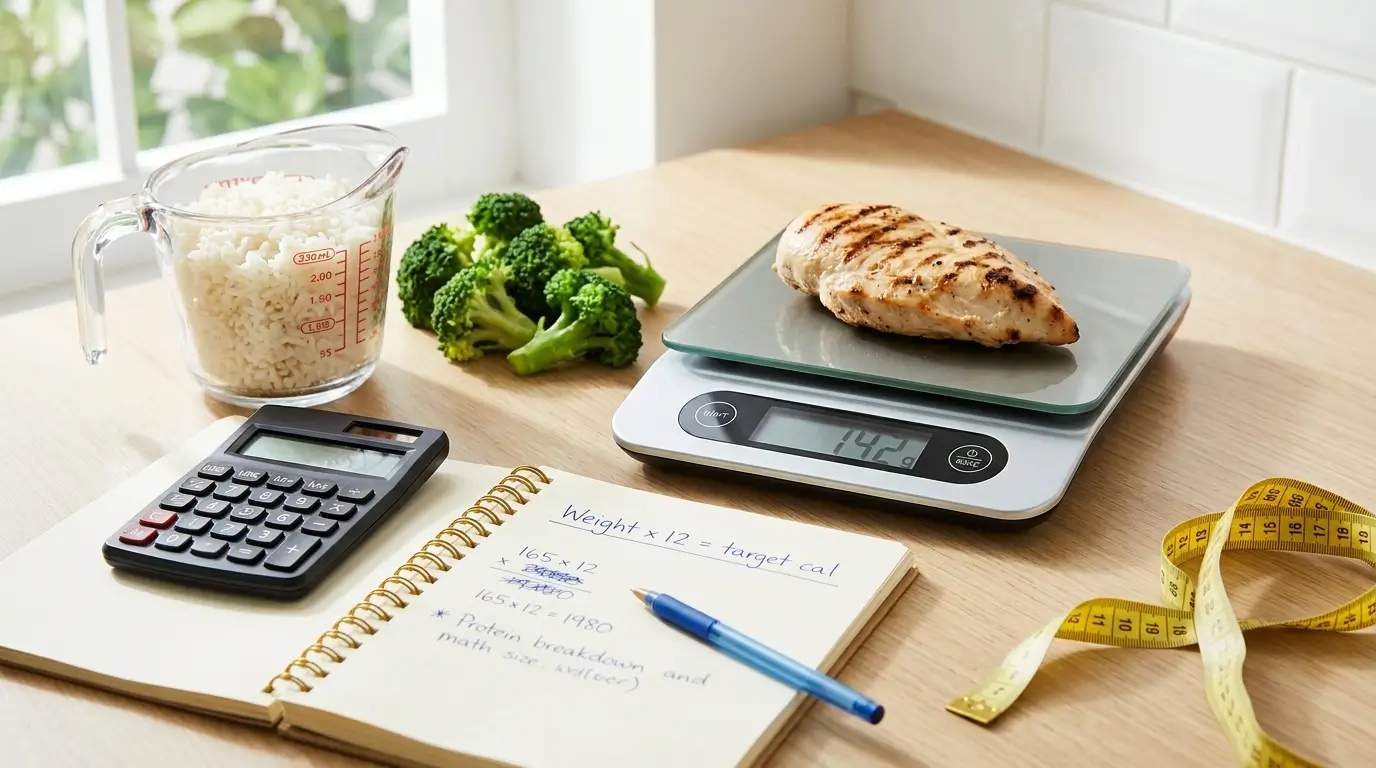
Calculating macros for weight loss comes down to five steps: estimate your calorie needs (TDEE), set a calorie deficit, lock in your protein target, set a fat minimum, and fill the rest with carbs. Done correctly, this gives you a sustainable plan that preserves muscle, keeps you full, and creates steady fat loss, typically about 0.5 to 1% of body weight per week.
This guide walks through the math with a worked example you can adapt to yourself. For the fastest version, plug your stats into the DrinkDigits Macro Calculator. It runs this entire calculation in seconds.
Step 1: Estimate Your TDEE
TDEE (Total Daily Energy Expenditure) is the total calories you burn in a day, including exercise. It is the starting point for every weight-loss plan.
The most-validated formula is the Mifflin–St Jeor equation (peer-reviewed in the American Journal of Clinical Nutrition, 1990).
For men: BMR = (10 × weight in kg) + (6.25 × height in cm) − (5 × age) + 5. For women: BMR = (10 × weight in kg) + (6.25 × height in cm) − (5 × age) − 161.
If you only need the resting figure, our BMR calculator returns it directly. Then multiply BMR by an activity factor:
| Activity level | Multiplier |
|---|---|
| Sedentary (desk job, no exercise) | 1.2 |
| Lightly active (1 to 3 light workouts per week) | 1.375 |
| Moderately active (3 to 5 workouts per week) | 1.55 |
| Very active (6 to 7 workouts per week) | 1.725 |
| Extra active (physical job + daily training) | 1.9 |
Swipe to see more →
That gives you TDEE, your maintenance calories. Eating this amount keeps your weight stable. Unit conversions: 1 kg = 2.205 lb, 1 inch = 2.54 cm. To skip the arithmetic, run your stats through the TDEE calculator for an instant maintenance estimate.
Step 2: Set a Calorie Deficit
To lose fat you need to eat fewer calories than you burn. Typical safe deficits:
| Deficit size | Expected weekly loss | Trade-off |
|---|---|---|
| 15% deficit | 0.5 to 0.75 lb per week | Lowest muscle loss. Slow but sustainable. |
| 20% deficit | about 1 lb per week | Standard moderate recommendation. |
| 25% deficit | 1.25 to 1.5 lb per week | Faster but harder to stick to. More muscle loss risk. |
| Over 30% deficit | Over 1.5 lb per week | Not recommended. High muscle loss, rebound risk. |
Swipe to see more →
Weight-loss calories = TDEE × (1 − deficit %)
For most people, a 20% deficit is the sweet spot between results and sustainability. Aggressive deficits work short-term but rarely produce lasting fat loss.
Step 3: Set Your Protein Target
Protein is the most important macro during a cut. It preserves muscle, increases satiety, and has the highest thermic effect (your body burns about 25% of protein calories just digesting it).
Research-backed protein targets during weight loss:
| Condition | Protein per lb bodyweight |
|---|---|
| Sedentary or light activity | 0.7 to 0.8 g |
| Active or strength training | 0.8 to 1.0 g |
| Very lean, heavy training | 1.0 to 1.2 g |
Swipe to see more →
A meta-analysis of 20-plus weight-loss studies (Helms et al., Int J Sport Nutr Exerc Metab, 2014) concluded 0.9 to 1.4 g per lb is optimal for lean-mass retention in trained athletes cutting.
Protein calories = protein grams × 4.
Step 4: Set Your Fat Minimum
Fat supports hormones (testosterone, estrogen), absorbs fat-soluble vitamins, and keeps you from feeling terrible. The minimum for hormonal function is roughly 0.3 g per lb bodyweight.
| Goal or preference | Fat target |
|---|---|
| Minimum for hormone health | 0.3 g per lb |
| Moderate fat approach | 0.4 g per lb |
| Higher-fat or lower-carb approach | 0.5 g+ per lb |
Swipe to see more →
Fat calories = fat grams × 9.
Step 5: Fill Remaining Calories with Carbs
Carbs are the adjustable macro. Whatever calories are left after protein and fat goes to carbs.
Carb calories = total daily calories − protein calories − fat calories. Carb grams = carb calories ÷ 4.
Worked Example: Sarah, 150 lb Woman Losing Weight
Sarah's stats:
- Age: 32
- Height: 5'6" (168 cm)
- Weight: 150 lb (68 kg)
- Activity: moderately active (3 to 5 workouts per week)
- Goal: lose 15 lb
Step 1: TDEE. BMR = (10 × 68) + (6.25 × 168) − (5 × 32) − 161 = 680 + 1,050 − 160 − 161 = 1,409 calories. TDEE = 1,409 × 1.55 = about 2,184 calories per day at maintenance.
Step 2: 20% deficit. Weight-loss calories = 2,184 × 0.80 = about 1,747 calories per day (round to 1,750).
Step 3: Protein (0.9 g per lb). Protein = 150 × 0.9 = 135 g (540 calories).
Step 4: Fat (0.4 g per lb). Fat = 150 × 0.4 = 60 g (540 calories).
Step 5: Remaining calories go to carbs. Carb calories = 1,750 − 540 − 540 = 670. Carbs = 670 ÷ 4 = about 168 g.
Sarah's daily targets:
| Macro | Grams | Calories | % of total |
|---|---|---|---|
| Protein | 135 g | 540 | 31% |
| Fat | 60 g | 540 | 31% |
| Carbs | 168 g | 670 | 38% |
| Total | 1,750 | 100% |
Swipe to see more →
Expected result: about 1 lb per week fat loss, muscle preserved, realistic hunger levels.
How Long Will This Take?
At about 1 lb per week, losing 15 lb takes roughly 15 weeks, or about 3.5 months. This is a feature, not a bug. Faster rates of weight loss consistently show worse long-term results because muscle loss accelerates past 1% body weight per week, hunger hormones (ghrelin, leptin) adapt and push back, adherence drops sharply at deeper deficits, and crash-diet weight returns 80% of the time within 2 years.
Adjusting Based on Progress
Track weight weekly (same day, same time, fasted). After 2 to 3 weeks:
| What's happening | Adjustment |
|---|---|
| Losing 0.5 to 1% bodyweight per week | Stay the course |
| Losing faster than 1.5% per week | Add 100 to 200 cal to carbs (too aggressive) |
| No weight loss for 2+ weeks | Cut 100 to 150 cal from carbs, or increase activity |
| Weight stalled and energy low | Re-check TDEE. Muscle loss may have dropped BMR |
Swipe to see more →
Common Mistakes That Kill Weight Loss
The most frequent one is underestimating calorie intake. Studies consistently show self-reported calories are 20 to 40% low. Weighing portions for two weeks is the cheapest way to calibrate. Another trap is relying on "low-fat" processed foods, which often replace fat with added sugar. Not eating enough protein (below 0.7 g per lb) leads to muscle loss and hunger crashes. Doing excessive cardio without lifting burns calories but also accelerates muscle loss, so strength training two to four times per week is important. Weighing daily and panicking at fluctuations misses the point: water weight varies plus or minus 3 lb day to day, and weekly trend is what matters. And "restart Monday" cycling, three strict days plus two binge days, usually produces no real deficit at all.
Practical Food Examples for Sarah's Plan (1,750 cal, 135P, 60F, 168C)
Breakfast (430 cal): two eggs, half a cup of oats, one cup of blueberries, Greek yogurt. Lunch (500 cal): six ounces of grilled chicken, mixed greens, half a cup of rice, one tablespoon of olive oil dressing. Snack (200 cal): a protein coffee drink and an apple. Dinner (550 cal): five ounces of salmon, one cup of rice, 1.5 cups of roasted vegetables, one teaspoon of olive oil. Evening (70 cal): cottage cheese.
Total: about 1,750 cal, 135 g protein, 60 g fat, 170 g carbs.
When to Adjust Protein, Fat, or Carbs
If you are feeling hungry constantly, increase protein or fiber rather than calories. If energy crashes during workouts, shift some fat calories to carbs on training days. Hormonal symptoms like low libido, feeling cold, or fatigue can signal that fat has dropped too low, in which case increase fat slightly and reduce the deficit. Hitting a plateau after six-plus weeks is often a sign to take a diet break at maintenance for one to two weeks before resuming.
Summary
Weight loss math is simple: calorie deficit, high protein, minimum fat, the rest as carbs. The hard part is execution. Consistent tracking, weighing portions, and sticking to the plan for the weeks it takes to see real results.
Use the Macro Calculator to run these numbers instantly, and read our macros explained guide if any of the terminology is new.
Sources & References
- Mifflin MD et al., Am J Clin Nutr (1990). Original Mifflin–St Jeor BMR equation.
- Helms ER et al., Int J Sport Nutr Exerc Metab (2014). Protein for lean-mass retention during cutting.
- NIH Office of Dietary Supplements: Protein. Evidence-based protein recommendations.
- USDA Dietary Guidelines for Americans. Official macronutrient guidance.
- International Society of Sports Nutrition: Protein Position Stand. Peer-reviewed protein timing and dosing.