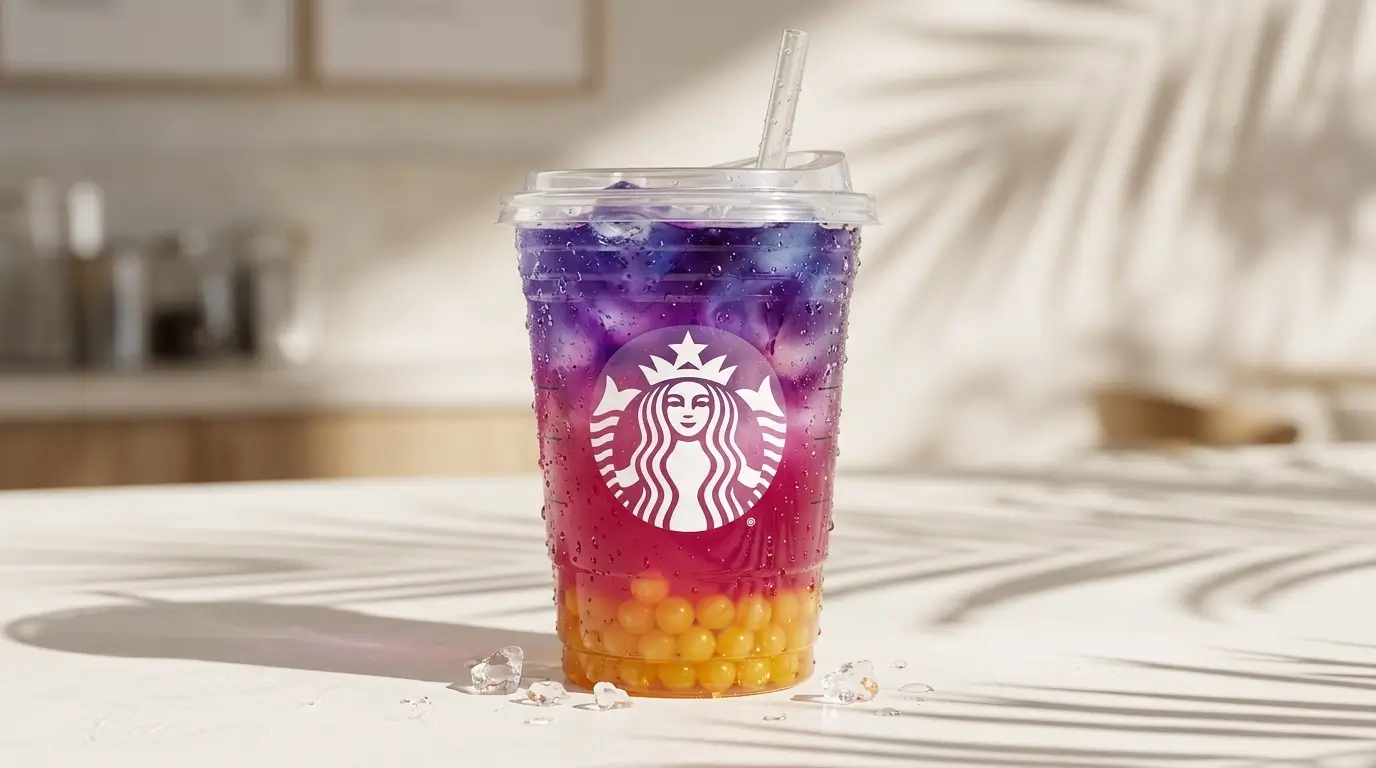
It launched at 6:00 AM on May 12, 2026 and your For You page hasn't stopped showing it since. A dark pink passionfruit-guava base. A purple butterfly pea flower infusion that bleeds down through it. Bright yellow mango-pineapple popping pearls sitting at the bottom like little suns. Five seconds into the video, someone squeezes a lemon into it and the whole thing flashes magenta. Three days in, "tropical butterfly refresher" is one of the most-searched Starbucks queries of the year.
A grande Tropical Butterfly Refresher on water carries 90 calories and 45 mg of caffeine from green coffee extract. The Lemonade version jumps to 140 calories and 30 grams of sugar. The Butterfly Drink swap (coconut milk in place of water) lands around 120 calories with a creamier mouthfeel. The Energy version adds guarana for a 125 mg caffeine hit. Four very different drinks, all built on the same passionfruit-guava base, none of them properly tabled anywhere else on the web. Here is the full breakdown, the color-change chemistry, the popping-pearl science, and a $1.30 copycat recipe that tastes the same.
Which Version Should You Order?
If you want the look without the sugar load, the water-base version is the only one under 100 calories. The Lemonade is the social-media version, the Butterfly Drink is the prettiest poured-over-ice, and the Energy version is the only one that legitimately replaces an iced coffee on caffeine.
What Launched on May 12, 2026
The Tropical Butterfly line dropped with Starbucks' Summer 2026 menu rollout. Three menu facts shape every number below:
- It is sold as four distinct drinks, not one with modifiers. "Tropical Butterfly Refresher" is the water version on the menu board. "Tropical Butterfly Lemonade Refresher," "Butterfly Drink" (the coconut milk version), and "Tropical Butterfly Energy Refresher" are separate menu entries with separate nutrition panels. Ordering "the butterfly drink" without specifying which one gets you the coconut milk version by default.
- The caffeine source is green coffee extract, not espresso or steeped tea. All Refreshers use the same green coffee extract base for caffeine. A standard grande Refresher runs 45 mg of caffeine. The Energy version layers in guarana for 125 mg grande (Starbucks' official Energy Refresher base figure).
- The color change is real and pH-driven, not food coloring. Butterfly pea flower contains anthocyanins, the same pigment class that turns red cabbage purple. In neutral water it is deep blue; introduce acid (lemon juice, the citric acid in the refresher base, or the passionfruit syrup) and it shifts toward magenta. That ombre effect is chemistry, not styling.
For deeper Starbucks Refresher context, see our Starbucks Refreshers vs iced teas breakdown, the caffeine half-life and sleep explainer for when to stop drinking these, and our broader Dunkin Spring Menu 2026 guide for the closest competitive launches.
What's in the Tropical Butterfly Refresher? (Full Ingredients)
Every Tropical Butterfly drink is built from the same core components:
- Base liquid: water, lemonade, or coconut milk depending on the version
- Passionfruit-guava flavoring: the tropical fruit base underneath the color change
- Butterfly pea flower infusion: the deep blue layer poured on top, which shifts through purple to magenta on contact with the acidic base (zero caffeine, zero calories on its own)
- Green coffee extract: the source of caffeine in the standard versions (45 mg grande)
- Guarana extract and B vitamins: added only in the Energy version, pushing caffeine to 125 mg
- Mango-pineapple popping pearls: a sodium alginate shell around mango-pineapple juice, spherified, vegan, no gelatin, roughly 30 calories and 6-8g sugar per serving
- Liquid cane sugar: the standard sweetener in the refresher base (can be reduced or removed on request)
Is it gluten-free? Yes, none of the ingredients in any of the four versions contain gluten. Starbucks does not certify its drinks for cross-contamination, so if you have celiac disease rather than a mild sensitivity, that is worth factoring in.
Is it vegan? Yes, all four versions are vegan and dairy-free, including the Butterfly Drink. Coconut milk is plant-based, and the popping pearls use no animal-derived gelatin.
Side-by-Side: All 4 Tropical Butterfly Versions (Grande)
All numbers are for grande (16 fl oz) at default recipe. Customizations such as no liquid cane sugar, light ice, or sub coconut milk change every column.
| Version | Base liquid | Calories | Sugar (g) | Carbs (g) | Caffeine (mg) | Protein (g) | Approx. Price |
|---|---|---|---|---|---|---|---|
| Tropical Butterfly Refresher | Water | 90 | ~22 | 22 | ~45 | 0 | $5.95 |
| Tropical Butterfly Lemonade Refresher | Lemonade | 140 | 30 | 33 | 45 | 0 | $6.25 |
| Butterfly Drink (coconut milk) | Coconut milk | 120 | 23 | 26 | 45 | 1 | $6.45 |
| Tropical Butterfly Energy Refresher | Water + guarana | ~120 | ~24 | ~25 | 125 | 0 | $6.45 |
Swipe to see more →
The water-base Refresher and Lemonade numbers are from Starbucks' published nutrition panels (Lemonade: 140 cal, 30g sugar, 33g carbs, 45 mg caffeine grande). The Butterfly Drink coconut-milk version is reported as 120 cal / 23g sugar / 26g carbs grande on third-party trackers; confirm against the Starbucks app for your store. The Energy Refresher caffeine is 125 mg grande per Starbucks' official Energy Refresher base; Energy calories and sugar are estimates pending the per-product panel. The mango-pineapple popping pearls add roughly 30 calories to whichever version you order; they are not stripped from the panel above.
Caffeine: Where It Comes From, How Much Is Actually In It
Starbucks does not publish caffeine for every Refresher variant, so this section is the part most other write-ups get wrong. Here is what is in the cup:
- Standard Refresher base (water or lemonade): green coffee extract delivers ~45 to 50 mg of caffeine per grande. This is roughly the same as a small cup of green tea, less than half a grande Pike Place coffee (235 mg).
- Energy Refresher base: green coffee extract plus guarana extract plus B vitamins. Net caffeine 125 mg per grande per Starbucks' Energy Refreshers product line, roughly equivalent to a tall Pike Place coffee (155 mg) or about a third of a grande Cold Brew (205 mg).
- Butterfly pea flower infusion: zero caffeine. Despite the deep blue color suggesting "tea," butterfly pea flower is not Camellia sinensis. It is from Clitoria ternatea, a legume, and has been measured at zero caffeine in multiple lab analyses.
- Popping pearls: zero caffeine. The pearls are spherified fruit juice in a sodium alginate shell.
The FDA's daily caffeine reference for most healthy adults is 400 mg/day. A Lemonade Refresher at 45 mg leaves you 355 mg of headroom; an Energy Refresher at 125 mg uses about 31% of your daily budget. For the math on when caffeine clears your system, see our caffeine half-life and sleep explainer.
Drink-by-Drink Breakdown
Tropical Butterfly Refresher (water base): lowest calorie
The original. A passionfruit-guava base shaken with ice, topped with a butterfly pea flower infusion that drifts down through the cup, finished with mango-pineapple popping pearls. At 90 calories and 22g of sugar on the grande, it is the only version that fits under the "snack-sized drink" line. The flavor is sharp, citrus-forward, with a tropical fruit core. The water base lets the passionfruit hit the front of the tongue and the pearls do the work on the finish.
Who it works for: anyone watching calories, anyone who finds Lemonade Refreshers too sweet, hot-weather sipping.
Tropical Butterfly Lemonade Refresher: the TikTok version
This is the one most reviewers are showing on social. Swapping water for lemonade pushes the drink to 140 calories and 30g of sugar (per Starbucks' published nutrition panel) and amplifies the color-change reaction because lemonade is more acidic than plain refresher base. The flavor reads as a tropical Arnold Palmer with bursts of mango-pineapple. Caffeine stays at the standard 45 mg.
Who it works for: visual-first orders, anyone who likes Pink Drink-style sweet refreshers, social media content.
Butterfly Drink (coconut milk base): the creamy one
"Butterfly Drink" is the menu name when the base is coconut milk instead of water. The opacity of coconut milk softens the color-change effect (it becomes more lavender-on-cream than pink-on-purple) but produces the most visually striking pour as the dark base hits the white milk. A grande lands at about 120 calories and 23g sugar (per third-party trackers; Starbucks has not yet published its own panel for the coconut-milk version). Mouthfeel is much creamier than either water or lemonade base. Caffeine still 45 mg.
Who it works for: people who default to the Pink Drink / Dragon Drink, anyone who wants a creamier finish, dairy-free drinkers.
Tropical Butterfly Energy Refresher: the caffeine version
The Energy variant uses Starbucks' Energy Refresher base, which adds guarana extract (and a small amount of B vitamins) on top of the standard green coffee extract caffeine. Net caffeine is 125 mg per grande per Starbucks' Energy Refreshers line, roughly equivalent to a tall Pike Place coffee (155 mg) or about two-thirds of a grande iced coffee (165 mg). Calories run slightly higher than the water version (~120) because the Energy base has small amounts of cane sugar to balance the guarana bitterness.
Who it works for: morning replacement for an iced coffee, anyone trying to ditch energy drinks but keep the caffeine, post-workout pick-me-up.
The Color Change Is Real Chemistry (Not Food Coloring)
The single most-screenshotted moment in the Tropical Butterfly launch videos is the pour: a dark blue cap on top of a magenta base, drifting downward in slow swirls. That is anthocyanin chemistry, not styling.
Butterfly pea flower (Clitoria ternatea) contains a family of pigments called ternatins, which are anthocyanins. Anthocyanins are pH-sensitive: they appear deep blue in neutral or basic solutions (pH 7+), purple in mildly acidic (pH 4-6), and pink to red in strongly acidic (pH below 4). When the blue butterfly pea infusion is poured onto the acidic passionfruit-guava base (citric acid, fruit acid, lemonade in the Lemonade version), the boundary layer between them shifts through purple to magenta in real time as the acids and water mix.
You can reproduce the effect at home with a quarter teaspoon of butterfly pea powder in hot water and a squeeze of lemon. This is the same chemistry used in red-cabbage pH indicator strips in middle-school chemistry labs, just consumed at $5.95 to $6.45 a cup.
The pigment is also a mild antioxidant, but the dose in a drink is small enough that no meaningful health claim is supported. Treat it as a beautiful natural dye, not a wellness ingredient.
What Popping Pearls Actually Are
The bright yellow spheres at the bottom of the cup are not tapioca boba. They are popping pearls (sometimes called popping boba or bursting pearls), and the production method is spherification.
The shell is made of sodium alginate, a naturally occurring polymer extracted from brown seaweed. The filling is mango-pineapple flavored juice (Starbucks does not publish the exact ratio). When the sodium alginate solution containing the juice is dropped into a calcium chloride or calcium lactate bath, the outside of each drop reacts instantly with the calcium to form a thin gel membrane, leaving the liquid juice inside intact. The result: a pearl with a fragile gel shell that bursts in your mouth.
Nutritionally:
- Roughly 30 calories per typical pearl serving (a tablespoon or so)
- ~6-8g of sugar from the fruit juice filling
- Vegan and plant-based (no animal-derived gelatin)
- Roughly one-fifth the calories per gram of cooked tapioca pearls (160-180 cal per equivalent serving)
If you want the visual without the extra calories, you can order any of the four Tropical Butterfly versions "no pearls" and save about 30 calories and 6-8g of sugar.
Butterfly Pea Flower: Safety Notes
Butterfly pea flower extract was approved by the FDA as a color additive exempt from certification (effective October 5, 2021, in response to Sensient's petition; see 21 CFR Part 73). This is the standard regulatory path for natural color additives. It is not a GRAS notification but is similarly restrictive on permitted uses. The dose in a single drink is well within tested ranges. Two things are worth flagging:
- Pregnancy and breastfeeding: there are no controlled human clinical trials evaluating butterfly pea flower consumption during pregnancy. Animal studies suggest the compounds are unlikely to be harmful at food-color doses, but registered dietitians and the WHO position is to "avoid or use only with clinician guidance" until human data is available. If you are pregnant, ask your OB before making butterfly pea flower a daily habit.
- Blood-thinner interaction: butterfly pea flower has mild antiplatelet activity in preclinical studies. If you take warfarin, clopidogrel, or daily aspirin, the dose in one drink is not clinically significant, but daily multi-cup consumption warrants a conversation with your prescriber.
For most healthy adults, a Tropical Butterfly Refresher is a normal beverage. These caveats are listed here because they are not on the Starbucks menu board and most write-ups omit them entirely.
How to Order It With Less Sugar
If you like the Lemonade version's flavor but the 30g sugar is too much:
- Sub water for the lemonade (cuts ~50 calories and ~8g sugar; you lose the tart edge)
- Half pumps of liquid cane sugar (Starbucks Refreshers come with sweetener built into the base; ask for "half sweet" or "no liquid cane sugar" to drop ~10-15g sugar at the cost of a more tart, less rounded flavor)
- Skip the popping pearls (saves ~30 calories and ~6-8g sugar; you lose the texture)
- Size down to tall (12 oz instead of 16 oz; roughly 25 percent less of everything)
- Sub unsweetened coconut milk for sweetened coconut milk (only matters if you're ordering the Butterfly Drink; saves ~5g sugar)
Combined, these moves can take a 140-calorie Lemonade Refresher down to roughly 75-85 calories and 12-15g of sugar while preserving the core passionfruit-guava-butterfly flavor.
DIY Copycat: Same Drink, $1.30 a Cup
The Starbucks version is $5.95 to $6.45 a grande. A reasonable home copycat lands at roughly $1.30 per drink once you have the pantry ingredients. The pantry buy is the upfront cost; per-cup math after that beats the cafe by about 80 percent.
What you need (pantry):
- Butterfly pea powder, 25g jar (~$10, makes ~50 drinks)
- Monin passionfruit syrup or equivalent (~$8 for 750 ml, makes ~20 drinks)
- Guava nectar or guava syrup (~$3 per 750 ml bottle, makes ~15 drinks)
- White grape juice, 64 oz bottle (~$4, makes ~10 drinks)
- Mango or pineapple popping pearls, 1 lb container (~$8, makes ~25 drinks)
- Citric acid, small jar (~$5, lasts forever)
The 5-step recipe (single grande):
- Mix the butterfly pea infusion: ⅛ teaspoon butterfly pea powder + 60 ml hot water, stir until uniform deep blue. Let cool.
- Build the base: 90 ml white grape juice + 30 ml guava nectar + 15 ml passionfruit syrup + pinch of citric acid. Stir.
- Add 1 tablespoon mango or pineapple popping pearls to the bottom of a 16 oz glass.
- Fill the glass two-thirds with ice. Pour the fruit base over the ice.
- Slowly pour the butterfly pea infusion on top. Watch the boundary color-change as it drifts down. Stir gently before drinking.
Per-cup cost: roughly $1.20 to $1.40. Per-cup time: under 3 minutes once the butterfly pea infusion is pre-made.
If you drink this three times a week, the pantry buy (~$38) pays for itself in week two and saves about $50 a month versus a cafe routine. For ordering Starbucks more generally, use our Starbucks Calorie Calculator to build the customizations against your daily macros.
Common Mistakes With This Order
Mistake 1: Ordering "the butterfly drink" without specifying which one. "Butterfly Drink" defaults to the coconut milk version (120 cal). If you wanted the water base (90 cal) or the Lemonade (140 cal but different flavor profile), you have to name it explicitly: "Tropical Butterfly Refresher" or "Tropical Butterfly Lemonade Refresher."
Mistake 2: Ordering the Energy version after 3 PM. Caffeine has a 5 to 6 hour half-life. A 4 PM Energy Refresher at 125 mg means roughly 62 mg is still circulating at 10 PM. If your sleep has been off this week, this is a likely contributor. The water and Lemonade versions at 45 mg are more forgiving.
Mistake 3: Assuming butterfly pea flower is caffeinated. It looks like a deep dark blue tea, but butterfly pea flower (Clitoria ternatea) has zero caffeine. All caffeine in this drink comes from the refresher base's green coffee extract.
Mistake 4: Pregnant and ordering it daily without checking with your provider. The dose in a single drink is well within tested food-color ranges, but human pregnancy data is limited. For occasional consumption it is generally safe; for daily multi-cup use during pregnancy, ask your OB first.
Mistake 5: Paying for popping pearls when you do not actually like them. The $0.80 pearl add is roughly 30 calories and 6-8g of sugar. Plenty of regulars order Tropical Butterfly drinks no pearls. The drink does not change color or taste; only the texture does.
Bottom Line: Which Tropical Butterfly Version to Order
If you only have one Tropical Butterfly Refresher slot in your week:
- For lowest calorie: the water-base Tropical Butterfly Refresher (90 cal, ~22g sugar, 45 mg caffeine)
- For the photo: the Tropical Butterfly Lemonade Refresher (most dramatic color change against the lemonade)
- For creamy mouthfeel: the Butterfly Drink with coconut milk (120 cal, softest finish)
- For caffeine that replaces an iced coffee: the Tropical Butterfly Energy Refresher (125 mg caffeine)
- For lowest cost: the DIY copycat above (~$1.30 a cup, same color chemistry)
The Summer 2026 menu also brought back the Iced Horchata Shaken Espresso (coming May 19 in select markets) and a new Horchata Frappuccino blended beverage; we will have a side-by-side on those soon. For Dunkin's competing summer launch (Dirty Pepsi, Oreo Cloud Latte, the Black Cherry Refresher line, Matcha Limeade), the Dunkin Spring Menu 2026 guide has the early breakdown.
Sources & References
- Starbucks Newsroom: Starbucks Previews 2026 Summer Menu. Official launch announcement and full menu list.
- Starbucks Newsroom: Summer Menu Arrives May 12. Confirmed launch date.
- Starbucks Tropical Butterfly Lemonade Refresher Nutrition. Official panel: 140 cal, 30g sugar, 33g carbs, 45 mg caffeine grande.
- Starbucks Tropical Butterfly Energy Refresher Product Page. Official menu listing.
- Federal Register: Listing of Color Additives Exempt from Certification, Butterfly Pea Flower Extract (Confirmation of Effective Date, Dec 29 2021). Official FDA color additive approval (effective Oct 5, 2021).
- FDA: Spilling the Beans, How Much Caffeine Is Too Much?. 200-400 mg daily reference.
- PMC: Anthocyanins from Clitoria ternatea, Chemistry and Bioactivity. Peer-reviewed review of butterfly pea pigment chemistry and pH behavior.
- American Heart Association: Added Sugars Recommendations. 25g/day women, 36g/day men reference.
- USDA FoodData Central. Reference data for coconut milk, lemonade base, and green coffee extract caffeine.