Walk into any cafe and the menu treats espresso and drip coffee like they live in different universes. They are made from the same beans. The difference is grind size, water pressure, contact time, and serving volume, and those four variables completely reorder which drink wins on caffeine, calories, taste, and cost.
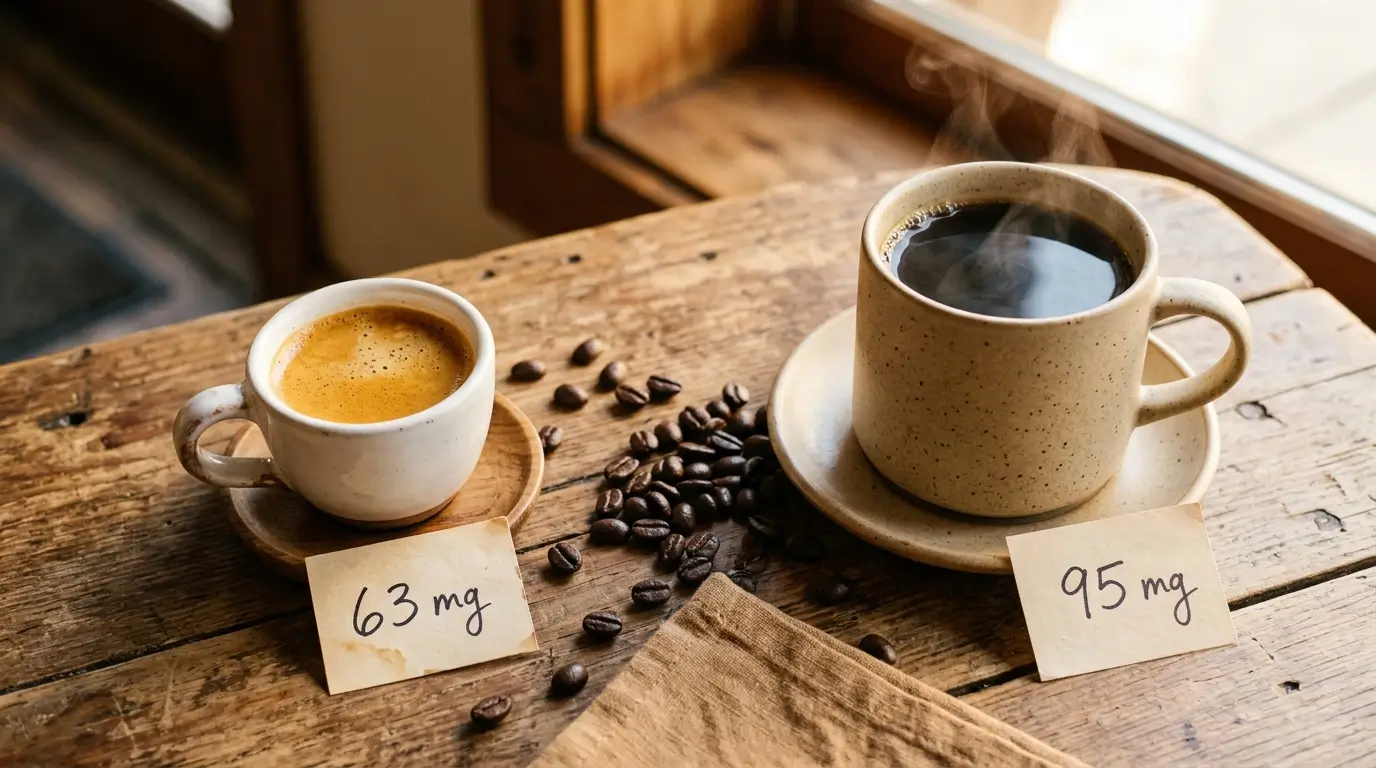
The short answer most people get wrong: a 1 oz espresso shot has 63 to 75 mg of caffeine. An 8 oz drip coffee has 95 mg. Per ounce, espresso is roughly 5× stronger. Per serving, drip coffee wins by ~50%. And a 16 oz Starbucks Cold Brew at 205 mg dunks on both of them at 3× a single espresso shot.
Here is the complete 2026 breakdown: caffeine per shot vs per cup, calories, taste profile, brewing science, antioxidants, cost, and which one is actually right for your morning.
Espresso vs Coffee at a Glance
| Metric | Espresso (1 oz shot) | Drip Coffee (8 oz) | Winner |
|---|---|---|---|
| Caffeine | 63–75 mg | 95 mg | Drip (per serving) |
| Caffeine per oz | ~64 mg/oz | ~12 mg/oz | Espresso (per oz) |
| Calories (black) | 1 cal | 2 cal | Tie |
| Brew time | 25–30 seconds | 4–6 minutes | Espresso (speed) |
| Antioxidants per cup | Low (small volume) | High (large volume) | Drip (per cup) |
| Cost at home | ~$0.25/shot | ~$0.10/cup | Drip (cheaper) |
| Taste | Concentrated, syrupy, sharp | Balanced, lighter, brighter | Preference |
Swipe to see more →
The headline: if "stronger" means caffeine concentration per ounce, espresso wins by ~5×. If it means total caffeine in your cup, an 8 oz drip coffee beats a single espresso shot every time, and a 16 oz Starbucks Cold Brew beats them both.
For the complete caffeine-content chart across 100+ drinks, see our caffeine in 100+ drinks chart. For when caffeine actually clears your system, see caffeine half-life and sleep.
What Espresso Actually Is
Espresso is brewed by forcing 195–205°F water at 9 bar of pressure through a tightly packed puck of finely ground coffee for 25 to 30 seconds, producing a 1 oz "shot" topped with a layer of caramel-colored foam called crema. The high pressure pulls dissolved CO₂ and emulsified oils into the cup, which is what gives espresso its syrupy mouthfeel and crema cap.
Origin: invented in Italy by Luigi Bezzera (patent 1901) and commercialized by Desiderio Pavoni (1906). The first commercial machines could brew a shot in seconds vs the multi-minute drip methods of the time, which is why it was called "espresso", from the Italian "express."
A single espresso shot is 30 ml (1 oz). A double shot ("doppio") is 60 ml (2 oz). Most cafe espresso-based drinks use a double shot as the base.
What Drip Coffee Actually Is
Drip coffee (also called filter coffee, brewed coffee, or pour-over depending on method) is made by gravity-pulling water through a bed of medium-ground coffee in a filter. Contact time is 4 to 6 minutes at brewing temperatures of 195–205°F. There is no pressure. The result is a clean, lighter-bodied cup at roughly 8 oz (240 ml) per serving.
The main drip methods:
- Automatic drip machine (Mr. Coffee, Bonavita): ~4–6 min, balanced, the American kitchen default
- Pour-over (Hario V60, Chemex): 2–4 min, brighter, cleaner cup
- French press: 4 min full immersion, fuller body, oily texture
- AeroPress: 1–3 min light pressure, hybrid clean-and-full
- K-Cup / single serve: 60–90 seconds, convenient but inconsistent extraction
Drip coffee is the dominant home-brewing method globally. Cold brew (12–24 hour cold steep) is technically drip-adjacent but works very differently chemically.
Caffeine: Per Shot vs Per Cup vs Per Ounce
This is where most "espresso vs coffee" articles get sloppy. There are three different measurements and they tell three different stories:
| Measurement | Espresso | Drip Coffee | Cold Brew |
|---|---|---|---|
| Caffeine per ounce | ~64 mg/oz | ~12 mg/oz | ~13 mg/oz |
| Caffeine per standard serving | 63–75 mg (1 oz shot) | 95 mg (8 oz cup) | 205 mg (16 oz grande) |
| Caffeine per cafe drink | 150 mg (latte, 2 shots) | 310 mg (Starbucks Pike Grande) | 205 mg (Starbucks Cold Brew Grande) |
Swipe to see more →
Per ounce, espresso wins by ~5×. This is the answer to "is espresso stronger than coffee?" if "stronger" means concentration.
Per serving (1 shot vs 1 cup), drip coffee wins by ~50%. A single espresso is a small serving. An 8 oz cup of drip is 8× the volume, and even at 1/5 the concentration, it totals more caffeine.
Per cafe drink, drip coffee wins by ~2–4×. A Starbucks Pike Place Grande (16 oz, 310 mg) easily beats a Starbucks Caffe Latte (16 oz with 2 espresso shots, 150 mg) because the latte is mostly milk, not espresso.
Caffeine: Every Common Coffee Drink at Starbucks Ranked
This is how the rankings shake out across Starbucks' menu, all grande sizes:
| Drink | Caffeine (mg) | What it actually is |
|---|---|---|
| Blonde Roast brewed | 360 | Drip coffee, lighter roast (more caffeine, less body) |
| Pike Place brewed | 310 | Drip coffee, medium roast (default house) |
| Featured Dark Roast | 260 | Drip coffee, dark roast |
| Caffe Americano | 225 | 3 espresso shots + hot water |
| Doubleshot on Ice | 225 | 3 espresso shots + classic syrup + ice |
| Iced Brown Sugar Oatmilk Shaken Espresso | 255 | 3 Blonde espresso shots + oatmilk + brown sugar |
| Cold Brew | 205 | Slow cold steep, no espresso |
| Vanilla Sweet Cream Cold Brew | 185 | Cold brew + cold foam |
| Caffe Mocha | 175 | 2 espresso shots + mocha sauce + milk |
| Iced Coffee | 165 | Hot-brewed strong, poured over ice |
| Caffe Latte | 150 | 2 espresso shots + steamed milk |
| Caramel Macchiato | 150 | 2 espresso shots + vanilla + milk + caramel |
| Cappuccino | 150 | 2 espresso shots + steamed milk + foam |
| Mocha Frappuccino | 110 | Blended, ~1 shot espresso |
| Single Espresso Shot | 75 | The base unit |
| Blonde Espresso Shot | 85 | Stronger espresso roast |
Swipe to see more →
Notice the pattern: straight drip coffee and cold brew dominate the top of the caffeine ranking. Espresso-based drinks (lattes, mochas, cappuccinos) cluster around 150–175 mg per grande because they only contain 2 shots of espresso.
For Dunkin's equivalent ranking, see our caffeine in 100+ drinks chart.
Calories: Black vs Milk-Based
Black, espresso and drip coffee are essentially calorie-free:
| Drink | Calories |
|---|---|
| Espresso shot (1 oz, plain) | 1 |
| Doppio (2 oz, plain) | 2 |
| 8 oz drip coffee, black | 2 |
| 16 oz drip coffee, black | 4 |
Swipe to see more →
Add milk and sugar and the math changes fast:
| Drink | Calories |
|---|---|
| 8 oz drip coffee + 1 tbsp cream + 1 tsp sugar | 50 |
| Cappuccino, Grande (8 oz milk) | 120 |
| Latte, Grande (16 oz, mostly 2% milk) | 190 |
| Mocha, Grande (with syrup + whip) | 370 |
| Caramel Macchiato, Grande | 250 |
| Pumpkin Spice Latte, Grande | 380 |
Swipe to see more →
Where calories come from in cafe drinks: milk, syrup, whipped cream. The espresso or coffee base contributes essentially zero.
For lower-calorie ordering at Starbucks, see our low-calorie Starbucks drinks under 150 calories guide.
Taste: What's Actually Different
The taste difference is bigger than the caffeine difference, and it comes from the brewing chemistry:
Espresso tastes like:
- Concentrated, syrupy, bittersweet
- A thick mouthfeel from emulsified oils (the crema)
- Pronounced bitterness from rapid extraction
- A sharp, lingering finish
- Notes of caramel, chocolate, sometimes fruit (depending on the bean)
Drip coffee tastes like:
- Cleaner, lighter body
- Brighter acidity (more soluble acids extracted over longer time)
- More nuanced flavor (more of the bean's character comes through)
- Smoother finish
- The same beans taste more "fruity" or "floral" via drip than via espresso
Cold brew tastes like:
- Smooth, naturally sweet
- Low acid (cold water does not extract acidic compounds well)
- Lacks the bright top notes of hot drip
- Often described as "chocolatey" or "mellow"
If you find espresso too intense, the move is not "drink less coffee." The move is to drink the same beans brewed via drip or pour-over. Same coffee, completely different cup.
Antioxidants: Per Ounce vs Per Cup
Coffee is one of the highest-antioxidant beverages in the standard American diet. The main bioactives are chlorogenic acids (CGAs), polyphenols that give coffee much of its antioxidant capacity.
| Method | CGAs per typical serving |
|---|---|
| Drip coffee, 8 oz | ~200–500 mg CGAs |
| French press, 8 oz | ~250–500 mg CGAs |
| Espresso shot, 1 oz | ~70–150 mg CGAs |
| Cold brew, 8 oz | ~150–400 mg CGAs (lower CGAs due to cold extraction) |
Swipe to see more →
Per ounce, espresso is the most concentrated. Per serving, drip and French press deliver the most antioxidants because of larger volume. Dark roast has lower CGAs than light/medium roast (roasting degrades polyphenols), which is why Starbucks Blonde Roast, a lighter roast, tests highest on both caffeine and antioxidants.
Brewing Methods Compared at a Glance
| Method | Grind | Water Temp | Time | Pressure | Resulting Strength |
|---|---|---|---|---|---|
| Espresso | Very fine | 195–205°F | 25–30 sec | 9 bar | High concentration, low volume |
| Drip / Pour-over | Medium | 195–205°F | 4–6 min | Gravity only | Moderate, balanced |
| French press | Coarse | 200°F | 4 min full immersion | None (immersion) | Full-bodied, oily |
| AeroPress | Medium-fine | 175–185°F | 1–3 min | Light pressure | Hybrid clean-and-full |
| Cold brew | Coarse | Room temp / cold | 12–24 hours | None | Smooth, low-acid, concentrate (dilute to serve) |
| Moka pot | Fine | Stovetop steam | 4–5 min | ~1.5 bar | Espresso-style at low pressure |
| K-Cup | Pre-ground (medium) | ~190°F | 60–90 sec | Light pump | Convenience-first, varies wildly |
Swipe to see more →
The variable that matters most: pressure. The 9-bar pressure in espresso machines is what extracts the dissolved CO₂ and oils that produce crema and that signature syrupy mouthfeel. No other brewing method generates pressure, which is why nothing else tastes like espresso.
Cost: Espresso vs Drip Compared
At home:
| Method | Equipment cost | Cost per cup |
|---|---|---|
| Drip machine (Mr. Coffee tier) | $30 | $0.10–0.20 |
| Pour-over (Hario V60) | $25 + kettle | $0.15–0.25 |
| French press | $30 | $0.15–0.25 |
| Espresso machine (Breville Bambino) | $300 | $0.25–0.40/shot |
| Espresso machine (semi-pro / La Marzocco) | $2,500+ | $0.20–0.30/shot |
| Cold brew pitcher | $30 | $0.10/cup (concentrate-diluted) |
Swipe to see more →
At a cafe:
| Drink | Starbucks (US average) | Dunkin (US average) |
|---|---|---|
| Drip coffee (medium/grande) | $2.95 | $2.45 |
| Espresso shot (single) | $2.95 | $2.95 |
| Latte | $5.45 | $4.45 |
| Cold brew | $5.25 | $4.45 |
| Cappuccino | $5.25 | $4.45 |
Swipe to see more →
Home-brewed drip coffee is the cheapest per cup; cafe lattes are the most expensive per oz of actual coffee (because you are mostly paying for milk and labor).
Best for X: Use Case Picker
- Best for fastest caffeine hit: Espresso shot (25 seconds, 75 mg in 1 oz)
- Best for total caffeine in your cup: Starbucks Cold Brew Grande (205 mg) or Pike Place Grande (310 mg)
- Best for smoothest taste: Cold brew (low acid, naturally sweet)
- Best for antioxidants: French press or pour-over light roast (high volume + high CGA retention)
- Best for budget: Home-brewed drip (~$0.10/cup)
- Best for sleep-friendly afternoon caffeine: Half-caf drip, max 100 mg before 2 PM
- Best for protein crossover: Premier Protein Cafe Latte (120 mg caffeine + 30g protein), see our review
- Best for low calories with flavor: Cold brew with sugar-free vanilla syrup and splash of oatmilk (~50 cal)
Common Mistakes
Mistake 1: "Espresso has the most caffeine." False. Per shot it has less than a cup of drip. Per ounce it has more, but you do not drink 8 oz of espresso.
Mistake 2: "Dark roast is stronger." False the other direction. Dark roast has slightly less caffeine per bean than light/medium roast because roasting partially degrades caffeine. Blonde Roast (lighter) is Starbucks' highest-caffeine brewed coffee.
Mistake 3: "Cold brew has less caffeine because it is smoother." False. The smoothness is from lower acid, not lower caffeine. A grande Starbucks Cold Brew has 205 mg, more than an Iced Coffee Grande at 165 mg, brewed from the same beans hot.
Mistake 4: "A latte is more caffeinated than drip coffee because it has espresso in it." False. A grande latte has 2 espresso shots = 150 mg. A grande Pike Place drip = 310 mg.
Mistake 5: "Espresso is fine before bed because it is small." A double espresso is still 150 mg. With caffeine's 5–6 hour half-life, 75 mg of that is still circulating 6 hours later. See our caffeine half-life and sleep guide for the timing math.
Bottom Line: Which Is Actually Stronger?
By concentration (per ounce): espresso wins by ~5×. By serving (1 shot vs 1 cup): drip coffee wins by ~50%. By cafe drink (latte vs Pike): drip coffee wins by ~2×. By cup at the top of the menu: Cold Brew or Blonde Roast wins outright (205–360 mg per grande).
The "espresso is stronger" myth survives because espresso feels stronger. The concentration hits the tongue in seconds, the crema reads as intensity, and the 25-second extraction creates ritual drama. The actual caffeine math says otherwise. If your morning needs maximum caffeine per dollar, brew drip coffee at home from a light-medium roast. If your morning is about ritual and a quick punch, espresso is unbeatable. They are different drinks, not stronger and weaker versions of the same thing.
For the complete caffeine ranking across 100+ drinks, see our caffeine in 100+ drinks chart. For matcha as a coffee alternative, see our Matcha Showdown: Starbucks vs Dunkin vs DIY guide. For the Refreshers caffeine path, see our Starbucks Refreshers vs iced teas guide.
Sources & References
- FDA: Spilling the Beans, How Much Caffeine Is Too Much?. 400 mg/day reference.
- Caffeine Informer Database. Lab-tested caffeine values for 1,200+ drinks including espresso and drip method comparisons.
- Starbucks Beverage Nutrition Information. Official Starbucks caffeine values for espresso and brewed coffee drinks.
- USDA FoodData Central. Reference values for brewed coffee and espresso.
- Ludwig et al. 2014, Coffee and Chlorogenic Acids: Bioavailability and Effects (PMC4173762). Chlorogenic acid content across brewing methods.
- Specialty Coffee Association: Brewing Standards. Official water temperature, contact time, and extraction guidelines.
- Illy: The History of Espresso. Bezzera/Pavoni patent history.
- Mayo Clinic: Caffeine Content of Common Beverages. Medical reference for caffeine ranges.