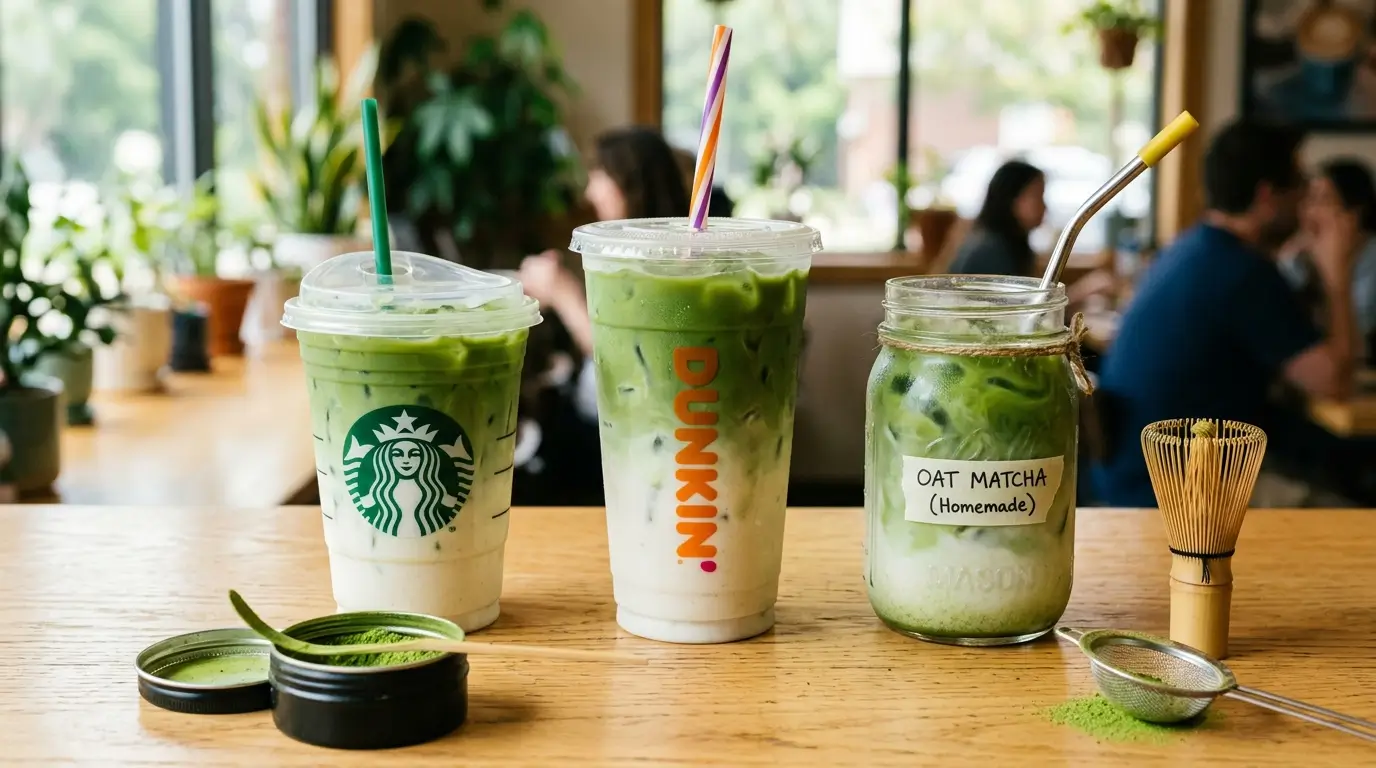
It is 9:42 AM and the line behind you at the Starbucks counter is six deep. Iced Matcha Latte: $5.95 grande. You scroll past the Dunkin a block over: same drink, medium, $4.49. Your phone has 30 grams of ceremonial-grade matcha sitting in a tin on your kitchen counter, $25 a month ago, still untouched. Three cups of green powder. Three very different decisions.
A grande Starbucks Iced Matcha Latte carries 28g of sugar. A medium Dunkin Iced Matcha Latte hits roughly 120 mg of caffeine, more than any standard Starbucks tea-side drink. A home-made iced matcha latte runs $1.40 and 7g of sugar, but you have to learn what "ceremonial grade" actually means first. Here is the side-by-side, the winners by category, and the recipe that pays for the matcha tin in week one.
What Changed in 2025-2026 Before You Read the Table
Three menu changes affect every number below:
- Starbucks reformulated its matcha powder to fully unsweetened in January 2025. The prior powder was pre-sweetened (added sugar baked into the matcha blend itself). The new powder has zero added sugar from the matcha component; the 28g of sugar in a grande default Iced Matcha Latte now comes almost entirely from the 4 pumps of classic syrup added at the bar. The default recipe still includes those 4 pumps, so finished-drink sugar lands around 28g unless you ask for fewer pumps. Iced lattes are also blended in a cold-foam pitcher now instead of shaken.
- Starbucks discontinued the Iced Matcha Lemonade on March 4, 2025. It is no longer on the US menu. The replacement is matcha customizations on the existing iced tea + refresher base, or the new Iced Protein Matcha launched September 29, 2025.
- Dunkin added three new matcha drinks in April 2026: Oreo Matcha, Vanilla Marshmallow Matcha, and Matcha Limeade. The standard Iced Matcha Latte (launched 2023) is still year-round. Dunkin's powder is pre-sweetened with sugar; there is no unsweetened-matcha option at Dunkin.
For deeper grade and brewing context, see our hot Starbucks matcha drinks guide, the caffeine half-life and sleep explainer, and the Starbucks vs Dunkin cold brew head-to-head.
The 5 Winners by Category
Best for taste: DIY with ceremonial-grade matcha
Ceremonial grade is stone-ground from the first spring harvest of shaded, hand-picked tea leaves. The price is real ($25 to $35 for 30g), but so is the difference. Vivid jade color, sweet vegetal taste, no chalkiness, no bitter aftertaste. Whisked into 170°F water with a bamboo whisk for 30 seconds and poured over cold oat milk, the result tastes nothing like the pre-mixed cafe blend. Cafe matcha is closer to premium-grade or culinary-grade powder optimized for stability and sweetness, not flavor depth.
Best for grab-and-go: Dunkin Iced Matcha Latte (medium)
Cheapest cafe matcha at ~$4.49, biggest cup at 24 oz, and roughly 120 mg of caffeine, which is higher than the Starbucks grande version (80 mg) and most non-coffee Starbucks drinks. The catch is that Dunkin's matcha is pre-sweetened. The single-serve bag is matcha plus sugar, so 32g of sugar lands in the cup whether you ask for it or not. There is no "no classic syrup" lever to pull. If your morning is "drive-through, large, fast," Dunkin wins on speed and caffeine. If you want lower sugar, you cannot get there at Dunkin.
Best for low sugar: Starbucks Iced Matcha Latte, no classic syrup
This is the trick the 2025 reformulation unlocked. The default recipe adds 4 pumps of classic syrup, which is where most of the 28g of finished-drink sugar comes from. Order "Grande Iced Matcha Latte, no classic syrup" and you drop to roughly 5g of sugar (lactose from milk only). Calories fall to ~110. Same matcha taste. Dunkin cannot do this because the sugar is in the powder itself, not the syrup line.
Best for protein: Starbucks Iced Protein Matcha
Launched September 29, 2025 (National Coffee Day) as part of Starbucks' protein-lattes line, this is the matcha version blended with whey-style protein into the base. 28g of protein in a grande iced; 51g in a venti iced. Calorie, sugar, and caffeine panels are not yet on every third-party tracker, so the exact macros beyond protein are still settling. For anyone running a post-workout caffeine + protein routine, this collapses the shake + iced coffee combo into one cup. Dunkin has no matching product.
Best for cost: DIY iced matcha latte
A $25 tin of ceremonial matcha makes 15 servings at 2g each. Oatly Barista at $5.50 a carton makes 4 cups at 240 ml each. Per cup: $1.40 to $1.55. That is a 75% discount on the Starbucks price. If you drink one cafe matcha per workday (~$120 a month), home-brewing saves roughly $90 a month with better-tasting matcha. The whisk and tin pay for themselves in the first week.
Side-by-Side: Default Recipes, Default Milk
All numbers below are for the default recipe at each location. Customizations change everything, especially syrup pump counts.
| Drink | Size | Calories | Sugar (g) | Caffeine (mg) | Protein (g) | Sodium (mg) | Approx. Price |
|---|---|---|---|---|---|---|---|
| Starbucks Iced Matcha Latte (2% milk) | Grande 16 oz | 200 | 28 | 80 | 9 | 120 | $5.95 |
| Starbucks Iced Matcha Latte, no classic syrup | Grande 16 oz | ~110 | ~5 | 80 | 9 | 120 | $5.95 |
| Starbucks Iced Protein Matcha | Grande 16 oz | n/a | n/a | n/a | 28 | n/a | $6.25 |
| Starbucks Matcha Crème Frappuccino | Grande 16 oz | ~420 | ~52 | ~65 | 6 | 240 | $6.45 |
| Dunkin Iced Matcha Latte (whole milk) | Medium 24 oz | 250 | 32 | ~120 | 11 | 130 | $4.49 |
| DIY Iced Matcha Latte (oat milk) | 16 oz | ~146 | ~7 | ~60 | ~3.5 | ~100 | $1.40 |
Swipe to see more →
Starbucks does not publish caffeine on most product pages. The 80 mg grande figure is consistent across multiple third-party trackers and matches the standard 3-scoop matcha recipe. The Iced Protein Matcha launched September 29, 2025 and only the 28g protein figure (grande iced) is officially confirmed; other macros are still being added to public trackers. Treat the Frappuccino sugar and caffeine numbers as approximate (range ±10%).
Caffeine: What the L-Theanine Actually Does
A grande Starbucks matcha latte at 80 mg of caffeine sits between an iced coffee (165 mg) and an unsweetened iced black tea (25 mg). A medium Dunkin matcha latte at ~120 mg sits roughly halfway between a Starbucks iced coffee and a Starbucks cold brew. DIY at ~60 mg per 2g serving is gentle by design.
The reason matcha caffeine feels different from coffee caffeine: matcha contains roughly 20 to 44 mg of L-theanine per gram (Unno et al., 2018, via PMC). L-theanine is an amino acid that slows caffeine absorption and pairs with it to create what most users describe as a "smoother, longer focus" curve instead of a sharp coffee spike followed by a crash. Coffee has zero L-theanine. A 2g ceremonial-grade matcha serving delivers about 40 to 80 mg of L-theanine alongside 60 to 70 mg of caffeine, which is the combination popular in nootropic and focus-stack routines.
Cafe matcha drinks contain less matcha per ounce than DIY (Starbucks uses ~3 small scoops in a grande), so the L-theanine dose per cafe drink is roughly half of what a 2g ceremonial-grade home preparation delivers, even at higher overall caffeine.
DIY Recipe: Grade Primer + 4-Step Iced Matcha Latte
Matcha grades: only one is worth brewing at home
Most "matcha powder" on grocery shelves is culinary grade: cheap, olive-brown, bitter, ground from older summer leaves. It tastes the way most people think matcha tastes, which is "weird grass." Cafe matcha is a step up (call it premium grade), pre-mixed with maltodextrin or sugar to mask bitterness and stabilize foam. Ceremonial grade is the only one that tastes the way matcha is supposed to taste.
| Grade | Origin | Caffeine (mg/g) | Color | Taste | Price ($/g) |
|---|---|---|---|---|---|
| Ceremonial | First spring harvest, shaded, stone-ground | 30–35 | Vivid jade green | Sweet, vegetal, smooth | $0.85–1.20 |
| Premium / Cafe | Spring + summer blend | 20–30 | Bright green | Mild astringency, smooth | $0.40–0.80 |
| Culinary | Summer/fall, older leaves | 15–25 | Olive-green | Bitter, chalky, "earthy" | $0.15–0.35 |
Swipe to see more →
(Caffeine ranges per PMC review of matcha chemistry; retail price ranges from US 2025-26 specialty tea surveys.)
The 4-step DIY iced matcha latte
What you need:
- 2g ceremonial matcha (about 1 teaspoon)
- 60 ml hot water at 170°F (above 180°F the catechins turn bitter)
- 240 ml oat milk (Oatly Barista preferred for foam) or any milk of choice
- A bamboo whisk (chasen, $15) OR a small electric milk frother
The steps:
- Sift the matcha into the bottom of a small bowl or wide cup. Sifting is the one step most people skip. Matcha clumps and will not whisk smooth otherwise.
- Add the 170°F water and whisk in a fast W-pattern for about 30 seconds until foamy and lump-free.
- Pour over ice in a tall glass.
- Add cold oat milk to fill. Stir.
Per-cup cost math:
- Matcha: $25 tin ÷ 15 servings = $1.67
- Oat milk: $5.50 carton ÷ 4 servings = $1.38
- Total per cup: roughly $1.40 to $1.55
If you make this four times a week, the matcha tin pays for itself in week one and you save about $90 a month versus a cafe routine. For a high-protein breakfast pairing, see our cottage cheese protein bowls post.
Three Orders You Can Screenshot
The Cafe Default (Starbucks): "Grande Iced Matcha Latte with oat milk, no classic syrup." About 110 cal, 5g sugar, 80 mg caffeine. Without "no classic syrup" the same drink is 200 cal and 28g sugar. The modifier is the only one that matters for sugar reduction at Starbucks.
The Caffeine Run (Dunkin): "Medium Iced Matcha Latte with whole milk, light ice." About 250 cal, 32g sugar, ~120 mg caffeine. Light ice gets you closer to a true 24 oz of liquid instead of 18 oz of liquid plus 6 oz of ice. Dunkin's matcha is pre-sweetened by design, so there is no unsweetened path here.
The Home Brew (DIY):
- 1 tsp ceremonial matcha (2g)
- 2 tbsp hot water at 170°F
- 1 cup oat milk
- Ice
Sift the matcha, whisk with hot water until foamy, pour over ice, top with cold oat milk. About 146 cal, 7g sugar (from oat milk only), ~60 mg caffeine, ~$1.40 per cup. Three minutes start to finish once you own the whisk.
Common Mistakes With This Order
Mistake 1: Assuming "matcha latte" means unsweetened green tea. Starbucks reformulated their matcha powder to unsweetened in January 2025, but the default Iced Matcha Latte recipe still adds 4 pumps of classic syrup. You have to ask for "no classic syrup" to actually drop the sugar load. Dunkin's matcha powder is itself pre-sweetened and cannot be ordered unsweetened.
Mistake 2: Drinking matcha after 3 PM. Caffeine has a 5 to 6 hour half-life. A 4 PM matcha at 60 to 120 mg of caffeine means roughly 30 to 60 mg is still circulating at 10 PM. If your sleep quality has been off, an afternoon matcha is a likely contributor. See our caffeine half-life and sleep post for the deeper math.
Mistake 3: Using boiling water on ceremonial matcha. Above 180°F, the catechins oxidize and the drink turns bitter. Aim for 170°F. If you do not own a thermometer: boil the water, pull it off the heat, wait 90 seconds, then pour.
Mistake 4: Buying "matcha powder" without checking the grade. A 200g bag at the grocery store for $15 is culinary grade. It will not taste like cafe matcha. The good stuff is $25 to $35 for 30g, sold in a sealed tin, with an origin (Uji, Nishio, or Kagoshima are the safe Japanese regions).
Mistake 5: Skipping the whisk and stirring with a spoon. Stirring gives you a clumpy, gritty drink with grass at the bottom. A $15 bamboo whisk or a $20 electric milk frother is the difference between a drink you actually finish and one you write off after the third sip.
Bottom Line
The Starbucks-versus-Dunkin matcha debate is real, but the bigger story is that DIY matcha is cheaper, tastier, and lower in sugar than any cafe option. If you drink matcha three or more times a week, a $25 tin of ceremonial-grade powder plus a $15 bamboo whisk saves roughly $300 a year and delivers better tea.
If you only drink matcha occasionally, the cafe pick depends on what you actually want:
- For lowest sugar at a cafe: Starbucks "no classic syrup" (~5g sugar, ~110 cal)
- For most caffeine in one cup: Dunkin medium with light ice (~120 mg caffeine, 24 oz)
- For most protein: Starbucks Iced Protein Matcha (28g)
- For the dessert version (which is what it is): Matcha Crème Frappuccino (~52g sugar, ~420 cal)
For more chain head-to-heads, see our Starbucks vs Dunkin cold brew and Starbucks Refreshers vs iced teas comparisons.
Sources & References
- Starbucks Matcha Reformulation Press Release
- Starbucks Iced Matcha Latte Product Page
- Starbucks Iced Protein Matcha Product Page
- Starbucks Matcha Crème Frappuccino Product Page
- Dunkin Iced Matcha Latte Product Page
- Unno et al. 2018, Matcha L-theanine Content (PMC6213777, Nutrients)
- American Heart Association Added Sugar Limits
- Oatly Barista Edition Nutrition