It's 10:47 PM. You crushed your lift, you already hit your protein target at dinner, and you're halfway through brushing your teeth when the question lands: do you actually need a casein shake right now, or is that 2010s gym-bro folklore?
The advice has been on Reddit since before Reddit was Reddit. The science has moved on twice since then. And the honest answer depends a lot on who you are, when you trained, and what your last real meal looked like.
Here's what the current research says about pre-sleep casein. When it works. When it doesn't. What the food alternatives are. And what to do at 10:47 PM if you don't want to drink chocolate cement at bedtime.
Medical disclaimer: The pre-sleep casein studies were done in healthy adults and resistance-trained athletes. Talk to your doctor before adding a high-protein supplement if you are pregnant, breastfeeding, have kidney or liver disease, or take medications that interact with high-protein intake.
What Casein Actually Is (in Plain English)
Milk protein is roughly 80% casein and 20% whey. The two proteins behave very differently the moment they hit your stomach:
- Whey stays liquid. Your body absorbs it in about 60 to 90 minutes. Amino acids in the bloodstream spike fast, then drop just as fast.
- Casein clots when it meets stomach acid. Digestion stretches out over 4 to 7 hours. Amino acids stay elevated the whole time.
That "clotting" behavior is the entire point of pre-sleep casein. It's a slow drip of amino acids during the long fasting window you spend asleep.
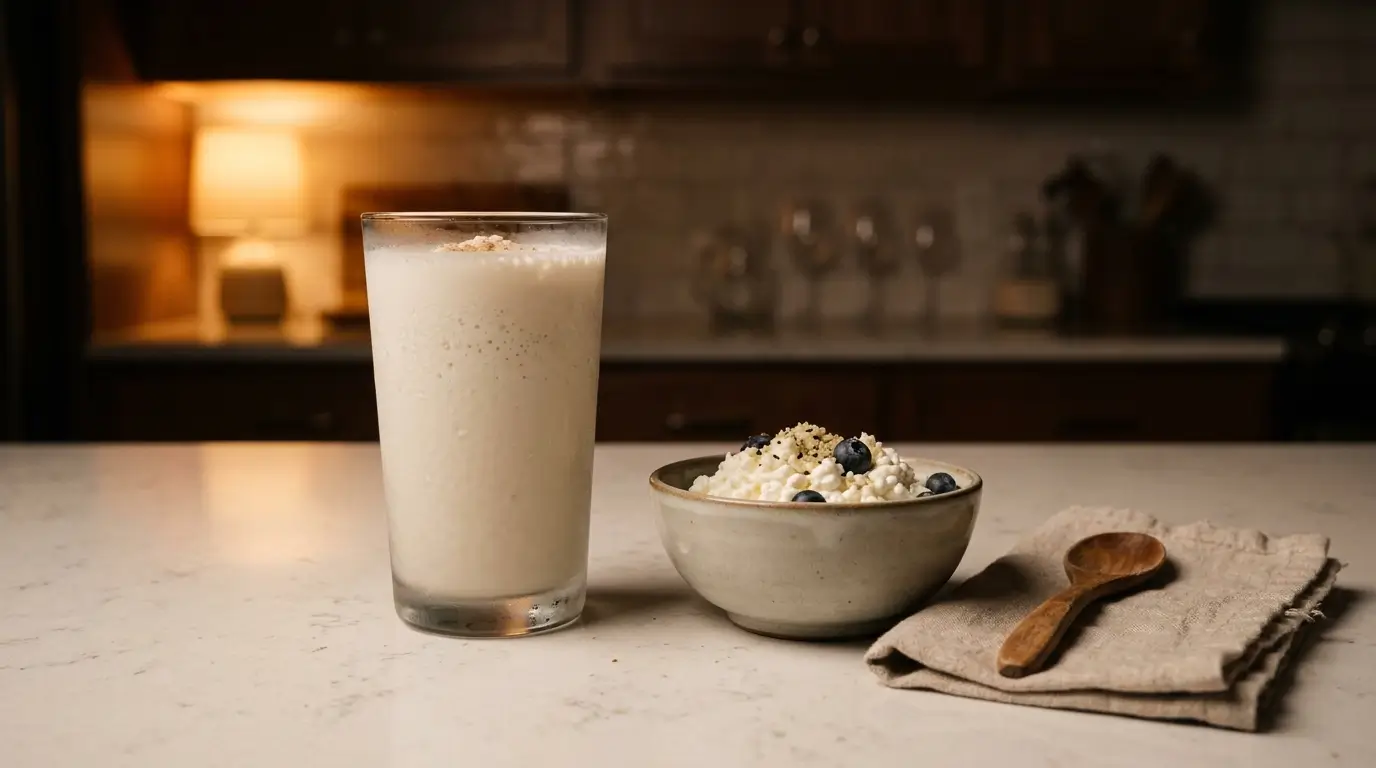
This is also why cottage cheese gets the same conversation. Cottage cheese is almost pure casein in food form. A 1-cup serving (4% milkfat) carries about 24g of total protein, and roughly 80% of that is casein. Same drip mechanism, different texture.
For the broader protein-quality picture, see our PDCAAS vs DIAAS protein score guide. Casein has a DIAAS of about 1.18, slightly higher than whey at 1.09.
What 14 Years of Pre-Sleep Casein Studies Show
The original pre-sleep casein paper is Res et al. (2012), Maastricht University, published in Medicine & Science in Sports & Exercise. Sixteen healthy young men did resistance training in the evening, then drank either 40g of casein or a placebo 30 minutes before sleep. The casein group showed roughly 22% higher overnight MPS than placebo.
The follow-up studies through 2024 narrowed the conclusions:
| Study | Year | Population | Pre-sleep dose | Result |
|---|---|---|---|---|
| Res et al. | 2012 | Trained men, evening lift | 40g casein | +22% overnight MPS |
| Snijders et al. | 2015 | Recreational lifters, 12 weeks | 27.5g casein + 15g carbs | +5 lb lean mass vs placebo |
| Trommelen & van Loon (narrative review) | 2016 | Synthesis of pre-sleep protein literature | n/a (review) | Confirmed 30–40g optimal pre-sleep dose; not an original RCT |
| Kouw et al. | 2017 | Older men (age 72), n=48 | 40g vs 20g vs 20g+leucine vs placebo | 40g produced significantly higher overnight MPS than 20g |
| Antonio et al. | 2017 | Resistance-trained men + women (mixed cohort), evening dosing | 54g casein vs whey | No significant body composition difference between proteins |
| Kouw et al. | 2023 | Trained men | 45g casein vs 45g whey vs placebo | Casein elevated overnight plasma amino acids longer than whey; both increased MPS over placebo |
Swipe to see more →
A 2020 systematic review in Journal of Science and Medicine in Sport (Reis et al.) concluded that pre-sleep protein is most effective when:
- Total daily protein is already adequate (1.4 to 2.0g/kg/day)
- The pre-sleep dose is at least 30g (40g is the dose most commonly studied)
- Training happened in the afternoon or evening
- The trainee is older than 50, where the leucine threshold per meal rises to ~3g
For the daily total side of this, our how to calculate daily protein intake guide walks through the math.
How Much Casein Do You Actually Need Before Bed?
The most studied dose is 40g. Useful real-world targets by goal:
| Goal | Pre-sleep casein dose | Why |
|---|---|---|
| Muscle gain (under 50) | 30 to 40g | Hits leucine threshold (~2.5g leucine), keeps MPS going overnight |
| Muscle gain (over 50) | 35 to 45g | Higher per-meal target (~3g leucine) for blunted MPS response |
| Recovery only (general training) | 20 to 30g | Lower dose works if daily total is already met |
| Fat loss (cutting) | 20 to 30g | Adds satiety overnight; calories still count |
| Sedentary, RDA-only protein | Not needed | Marginal benefit if daily protein is ~0.8g/kg |
Swipe to see more →
A 140 lb (64 kg) lifter targeting 1.6g/kg would need 102g of daily protein. If three meals already deliver 75g, a 30g casein shake before bed lands them at the daily target with the overnight bonus baked in. That's the typical real-world use case.
Casein Shake vs Cottage Cheese vs Greek Yogurt
You don't need a powder. Real food can do this job. The catch is dose density.
| Source | Serving | Protein | ~Casein | Calories | Pros | Cons |
|---|---|---|---|---|---|---|
| Casein shake (ON Casein) | 1 scoop in water | 24g | 24g | 110 to 120 | Easy, low cal, hits dose | Thick texture, polarizing taste |
| 4% cottage cheese | 1 cup (226g) | 24g | 19g | 220 | Real food, satiating | Sodium 700+ mg |
| 2% Greek yogurt (plain) | 1 cup (245g) | 24g | 19g | 200 | Versatile, gut benefits | Sugar in flavored versions |
| Low-fat cottage cheese | 1 cup | 28g | 22g | 180 | Higher protein, lower fat | Same sodium issue |
| Skyr (Siggi's plain) | 5.3 oz (150g) | 15g | 12g | 100 | Cleanest macro profile | Need 1.5 servings for full dose |
Swipe to see more →
A few honest notes on the table:
- Sodium in cottage cheese is the real-world drawback. One cup of standard cottage cheese delivers about 30% of the daily sodium limit. If you eat it nightly, swap to "no salt added" cottage cheese to drop the sodium by 90%.
- Flavored Greek yogurt can hide 12 to 18g of added sugar per cup. Plain is the safer default; add a teaspoon of honey or some berries if you need flavor.
- Sugar in shakes depends on the brand. ON Gold Standard Casein has about 3g per scoop. Cheaper blends sometimes use 8 to 10g of dextrose to mix better.
For 8 cottage cheese ideas that hit 25 to 30g protein, see our cottage cheese protein bowls guide. For more no-shake protein patterns, our 30g protein without a shake breaks down what real food can do.
Who Casein Before Bed Actually Helps
Looking at the evidence honestly, the people who benefit most are:
1. Evening lifters trying to gain muscle. If your workout ends at 7 PM and dinner ends at 8, you have a 10-hour fast before breakfast. Pre-sleep casein keeps amino acid levels up across the recovery window. The Snijders 2015 study saw real lean-mass gains over 12 weeks in exactly this group.
2. Anyone over 50. Muscle protein synthesis becomes less responsive with age (anabolic resistance). Per-meal protein doses need to rise from ~20g to ~30g to trigger the same MPS response. A larger casein dose at night helps offset the overnight gap. See our protein powder for women post for the postmenopausal case in detail.
3. People struggling to hit daily protein targets. If you've eaten ~70g by 7 PM but your target is 110g, a pre-sleep casein shake gets you to the daily total without needing a fourth full meal.
4. Anyone in a calorie deficit who wakes up hungry. Casein clots in the stomach. Real, sustained fullness. A 110-calorie casein shake at 10 PM does more for 3 AM hunger than a 110-calorie spoonful of peanut butter.
Who Should Skip Pre-Sleep Casein
It's not for everyone:
- You eat dinner late. If your last meal ended at 9 PM and you're in bed by 10:30, your amino acid levels are still elevated from dinner. Adding casein 30 minutes before sleep won't add much.
- You hit your daily protein target with three big meals. If you're eating 30g+ at each of breakfast, lunch, and dinner, the curve smooths itself out and the overnight gap shrinks.
- You have GERD or reflux. Casein clots, takes hours to clear, and lying down compounds reflux. Try drinking it 90 minutes before bed instead of 30 minutes, or skip it.
- You're lactose intolerant. Casein shakes carry trace lactose. Hydrolyzed casein or lactose-free options exist but cost more.
The Best Casein Sources in 2026
For dose, cost, and label cleanness, these are the five we'd put in a cart today:
1. Optimum Nutrition Gold Standard 100% Casein (Chocolate Supreme)
The default pick for most people. 24g of micellar casein per scoop, 110 calories, DIAAS 1.18. About $50 for a 4 lb tub (~$0.94 per serving). Mixes well in cold water or unsweetened almond milk.
2. Dymatize Elite Casein (Rich Chocolate)
Slightly higher dose at 25g per scoop. Sweetener blend is sucralose-heavy. About $40 per 4 lb tub. Good runner-up if Gold Standard is out of stock.
3. Six Star 100% Casein
Budget pick. 21g protein per scoop, ~$25 for a 2 lb tub. Lower protein-to-cost ratio than Gold Standard, but the cheapest entry point if you're just testing if pre-sleep casein works for you.
4. Naked Casein (Unflavored)
Cleanest label. One ingredient: micellar casein. No sweeteners, no flavors, no thickeners. About $80 for a 5 lb tub. Worth it if you have allergies or sensitivities to artificial sweeteners.
5. 4% Cottage Cheese (Good Culture, Daisy, or store brand)
Real food. Good Culture organic 4% delivers 19g protein per 5.3 oz container (~$2.50), with about 360 mg sodium. Larger 1 cup formats hit 24g protein. Try "no salt added" versions if you eat it every night.
For the broader protein powder rankings, see our best protein powders 2026 guide. For an explicitly women-focused breakdown, our protein powder for women post covers it.
Common Mistakes With Pre-Sleep Casein
Mistake 1: Stacking it on a day you already hit 2g/kg. More is not more. If you've already nailed daily protein, the extra 40g doesn't compound, it just gets oxidized as energy.
Mistake 2: Treating it like a magic pill. Pre-sleep casein added about 5 lb of lean mass over 12 weeks of consistent training in the Snijders study. That's real, but it's not transformative on its own. Training is still doing most of the work.
Mistake 3: Drinking 8 oz of milk and counting it as a casein dose. A cup of 2% milk has about 8g of protein, ~6g of which is casein. You'd need 5 cups of milk to hit a 30g casein dose. Cottage cheese or a shake is far more efficient.
Mistake 4: Mixing casein with hot liquid. Casein clumps in hot water. Use cold water or cold milk. Almond milk is fine and saves calories.
Mistake 5: Drinking it 15 seconds before lying down. Give yourself 20 to 30 minutes upright. Helps digestion and cuts reflux risk.
Bottom Line
If you train in the evening, you're over 50, or you struggle to hit your daily protein target with three meals, pre-sleep casein has 14 years of decent evidence behind it. The dose that works is 30 to 40g. Cottage cheese and Greek yogurt are the real-food versions of the same idea.
If you're sedentary, eat a late dinner, or already hit 2g/kg from food, you can skip the shake. The marginal gain isn't worth the bedtime hassle.
Sources & References
- Res et al. (2012), Protein ingestion before sleep improves postexercise overnight recovery (PubMed 22330017, Med Sci Sports Exerc)
- Snijders et al. (2015), Pre-sleep protein increases muscle mass and strength gains in young men (PubMed 25926415, J Nutr)
- Trommelen & van Loon (2016), Pre-sleep protein ingestion, narrative review (PubMed 27916799, Nutrients)
- Reis et al. (2020), Effects of pre-sleep protein consumption, systematic review (PubMed 32811763, Journal of Science and Medicine in Sport)
- Kouw et al. (2017), Protein ingestion before sleep increases overnight muscle protein synthesis in older men (PubMed 28855419, J Nutr)
- Kouw et al. (2023), Pre-sleep casein vs whey overnight amino acid kinetics in trained men (PubMed 36857005)
- ISSN Position Stand on Protein and Exercise (PMC5477153)
- USDA FoodData Central, Cottage Cheese 4% milkfat
- Optimum Nutrition Gold Standard 100% Casein