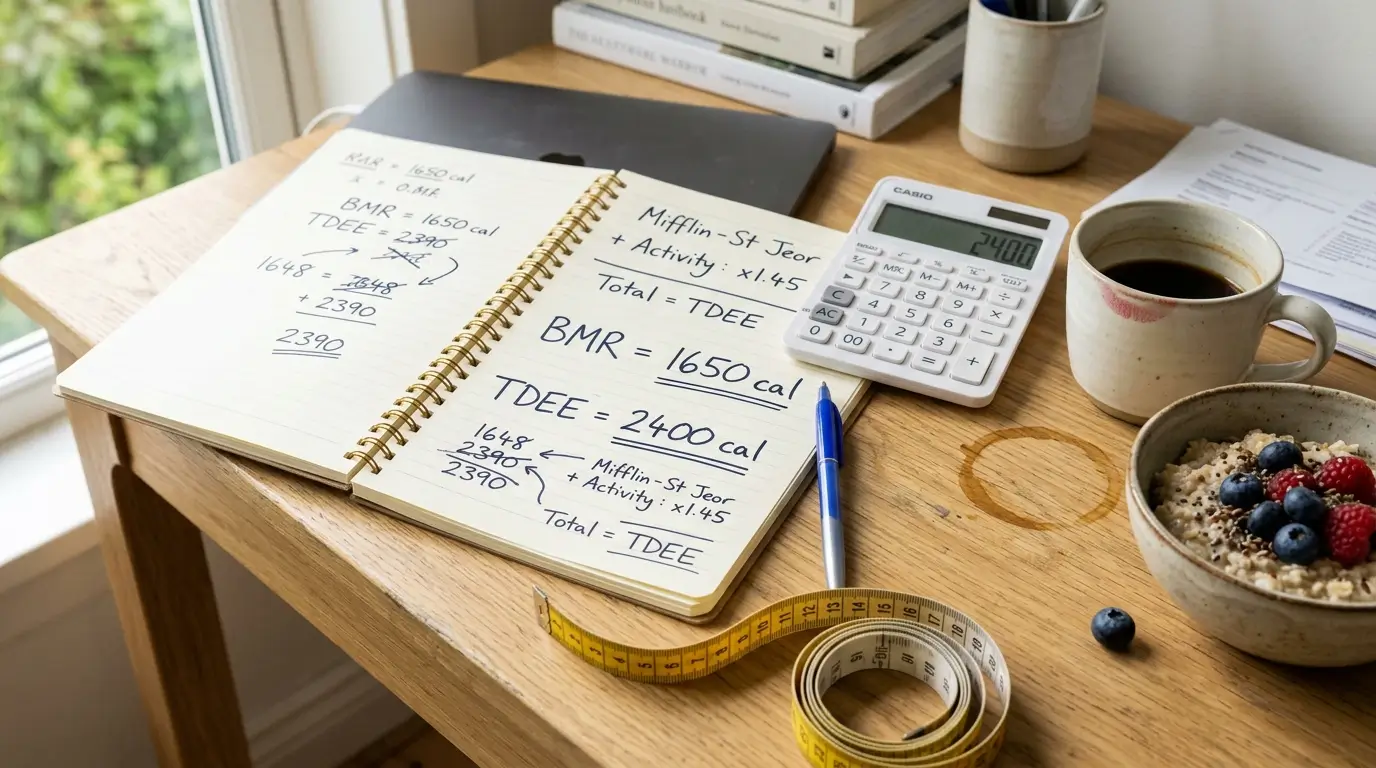
BMR vs TDEE: The Difference in Plain Terms
BMR (Basal Metabolic Rate) is the number of calories your body burns performing essential functions at complete rest: breathing, circulating blood, maintaining body temperature, running your brain. For most adults this lands between 1,200 and 1,900 calories.
TDEE (Total Daily Energy Expenditure) is the total your body burns across an entire day. It is your BMR plus exercise, daily movement, and digestion. TDEE is always higher than BMR, usually by 25 to 80%.
If you are setting a calorie target for weight loss, muscle gain, or maintenance, TDEE is the number to use. Eating at your BMR alone is a near-starvation deficit for anyone who moves.
If you have ever run a calorie or macro calculator and seen two different numbers come out, you have run into this exact question. Both numbers describe how many calories your body burns. They count different things, and picking the wrong one is how people end up on a 1,400 calorie target that they cannot sustain for more than nine days.
Here is what each number means, how each is calculated, and which one applies to your goal.
What Is BMR?
Basal Metabolic Rate is the minimum energy your body needs to stay alive. Even asleep and completely still, your body is running:
- Breathing
- Pumping blood
- Regulating body temperature
- Repairing cells
- Supporting brain function
- Maintaining organ activity
All of that costs calories. Resting metabolism accounts for roughly 60 to 70% of total daily calorie burn in most adults, which makes it the single largest component of what you burn.
Your BMR is shaped by age, sex, height, weight, muscle mass, genetics, and hormonal health. Someone carrying more lean muscle generally has a higher BMR, because muscle tissue costs more to maintain at rest than fat tissue does.
What Makes Up Your BMR
BMR is not evenly spread across the body. It breaks down roughly like this:
| System | % of BMR |
|---|---|
| Liver | 27% |
| Brain | 19% |
| Skeletal muscle | 18% |
| Other tissues | 19% |
| Kidneys | 10% |
| Heart | 7% |
Swipe to see more →
This is the honest version of "muscle boosts your metabolism." It does, but modestly. Adding 5 lb of muscle adds roughly 25 to 50 calories per day to BMR. Real, but not the transformation the gym floor promises. The bigger metabolic payoff from lifting is what it does to your activity level and body composition over time.
What Is TDEE?
Total Daily Energy Expenditure is everything you burn in 24 hours. Unlike BMR, it reflects how you actually live. It has four components.
1. Basal Metabolic Rate. Your resting burn, covered above. The largest slice.
2. Exercise Activity Thermogenesis (EAT). Calories from intentional training: running, cycling, swimming, lifting. A 30 minute moderate run is about 300 calories. An hour of weight training is typically 150 to 250.
3. Non-Exercise Activity Thermogenesis (NEAT). Everything you burn moving around outside of workouts: walking to the printer, standing, chores, gardening, taking the stairs, carrying shopping. NEAT is the most volatile piece of the whole equation. Two people with identical BMRs can differ by 600 to 800 calories per day on NEAT alone. This is a large part of why one person "can eat anything" and another cannot.
4. Thermic Effect of Food (TEF). Digesting and absorbing food costs calories. It is not equal across macros:
| Macronutrient | Thermic effect |
|---|---|
| Protein | 20 to 30% |
| Carbohydrates | 5 to 10% |
| Fat | 0 to 3% |
Swipe to see more →
On a mixed diet TEF works out to roughly 10% of total intake. It is also one of the quieter reasons higher-protein diets feel effective.
There is a fifth factor worth knowing about: adaptive thermogenesis. Your body nudges its burn up or down depending on whether you are in a surplus or a deficit. It is why fat loss slows over months even when your logging stays honest. The math did not change. Your body did.
How BMR and TDEE Connect
They are not competing numbers, and TDEE is not a separate calculation. Every TDEE estimate starts with BMR and then adjusts it for how much you move.
Think of BMR as the foundation and TDEE as the finished building. You cannot get to one without the other, and BMR is the largest share of the total.
How BMR Is Calculated
Several equations exist. The one to use is Mifflin-St Jeor, published in the American Journal of Clinical Nutrition in 1990 and still the standard across dietetics and sports science.
Men: BMR = (10 × weight in kg) + (6.25 × height in cm) - (5 × age) + 5
Women: BMR = (10 × weight in kg) + (6.25 × height in cm) - (5 × age) - 161
The alternatives:
- Harris-Benedict (1919, revised 1984) tends to overestimate BMR by 5 to 10% in modern adults.
- Katch-McArdle can be more accurate for very lean or very muscular people, because it runs off lean body mass rather than total weight. It requires knowing your body fat percentage, which most people do not know accurately.
No predictive equation measures your metabolism. They estimate it from population averages. True BMR measurement requires indirect calorimetry in a lab. You can skip the arithmetic with our BMR calculator.
How TDEE Is Calculated
Once you have BMR, multiply it by an activity factor.
TDEE = BMR × Activity Multiplier
| Activity level | Multiplier | Who it fits |
|---|---|---|
| Sedentary | 1.2 | Desk job, no exercise, low daily step count |
| Lightly active | 1.375 | Desk job with 1 to 3 light workouts per week |
| Moderately active | 1.55 | Active job, or 3 to 5 workouts per week |
| Very active | 1.725 | Physical job, or 6 to 7 workouts per week |
| Extra active | 1.9 | Physical job plus daily training |
Swipe to see more →
Most people overestimate here. If you train four times a week but spend the other 100 waking hours sitting, you are moderately active, not very active. When you are between two levels, pick the lower one and adjust later.
Worked Example: BMR vs TDEE Side by Side
Profile: 30 year old male, 180 cm (5'11"), 80 kg (176 lb), moderately active (trains 3 to 5 days per week)
Step 1: BMR
BMR = (10 × 80) + (6.25 × 180) - (5 × 30) + 5
BMR = 800 + 1,125 - 150 + 5
BMR = 1,780 calories per day
If he stayed in bed for 24 hours and did nothing, his body would still burn 1,780 calories on breathing, circulation, brain activity, and organ function.
Step 2: TDEE
TDEE = 1,780 × 1.55
TDEE = 2,759 calories per day
That is what he actually burns on a normal day with work, walking, and training included.
Step 3: What that means
| Daily intake | Result |
|---|---|
| About 2,760 calories | Maintain weight |
| About 2,260 to 2,460 calories | Gradual fat loss (300 to 500 deficit) |
| About 2,960 to 3,160 calories | Support muscle gain (200 to 400 surplus, with resistance training) |
Swipe to see more →
The gap between the two numbers is the whole point: 979 calories. Set his target off BMR instead of TDEE and he is eating a 979 calorie deficit without meaning to.
A second example, using the women's equation. A 35 year old woman, 168 cm (5'6"), 66 kg (145 lb), lightly active:
BMR = (10 × 66) + (6.25 × 168) - (5 × 35) - 161 = 1,374 calories
TDEE = 1,374 × 1.375 = 1,889 calories
Want your own numbers instead of an example? Skip the arithmetic and get your personalized figures in seconds: Find your BMR or Find your TDEE.
BMR vs TDEE for Weight Loss
Use TDEE. Fat loss happens when you consistently eat below what you burn in a full day, and that full-day number is TDEE.
| Daily intake | Result |
|---|---|
| Above TDEE | Weight gain |
| At TDEE | Maintenance |
| Below TDEE | Weight loss |
Swipe to see more →
A deficit of 300 to 500 calories per day (roughly 10 to 20% below TDEE for most people) is the usual recommendation. It is aggressive enough to show on the scale within a few weeks and moderate enough to preserve muscle, training quality, and your ability to stick with it. Public health guidance from the CDC points the same direction: gradual, sustainable change beats aggressive restriction.
For our 2,759 example, that is 2,260 to 2,460 calories per day.
Do not set your intake at your BMR. It is not a "safe minimum," it is the floor of biological function with zero allowance for the life you actually live. As a practical guardrail, most nutrition professionals suggest not dropping below about 1.1 × BMR for women or 1.2 × BMR for men during normal fat loss. In our example that floor is about 2,136 calories, so the 2,260 target clears it comfortably. Very low calorie diets under 1,200 calories are medically supervised interventions for severe obesity, not a fat loss shortcut.
For the full breakdown including protein targets, see how to calculate macros for weight loss.
BMR vs TDEE for Muscle Gain
Also TDEE, in the other direction.
Building muscle needs three things together: progressive resistance training, enough protein, and a modest calorie surplus. Miss any one and you get either no growth or unnecessary fat gain.
- Start from your TDEE
- Add 200 to 400 calories per day (about 5 to 15%)
- Keep protein high enough to support growth
For our example, that is 2,960 to 3,160 calories per day. Bigger surpluses do not build muscle faster. Past a point, the extra calories only go one place. If you are deciding between phases, cutting vs bulking macros covers how to structure each.
BMR vs TDEE for Weight Maintenance
If you are happy where you are, eat at your TDEE.
The catch is that TDEE is not permanent. It shifts as your weight changes, as muscle mass changes, as your job changes, as your training changes, and as the seasons change your daily step count. Recalculate after any meaningful weight change, after a shift in activity, or every few months if you are actively chasing a goal.
Why Your Calculated TDEE Is an Estimate, Not a Promise
Any TDEE you calculate comes from population averages. For any individual it can be off by 10 to 15% in either direction, because of:
- NEAT differences (some people fidget, some do not, and it is worth hundreds of calories)
- Muscle mass that a weight-based formula cannot see
- Adaptive metabolism, slightly lower in chronic dieters and slightly higher in overfeeders
- Honest error in how you rated your own activity level
So treat the number as a starting point, not a verdict. Eat at it for 2 to 3 weeks, weigh yourself weekly at the same time under the same conditions, and adjust by 100 to 200 calories based on what actually happened. Your real TDEE is whatever intake holds your weight steady, and three weeks of data beats any equation.
When BMR Alone Is Useful
BMR is not useless, it is just not a calorie target. It earns its place in three situations:
- As a floor. It anchors the 1.1× and 1.2× guardrails above.
- In clinical settings. It is used to set protein targets in medically supervised low-calorie diets.
- As a tracking metric. Recalculating BMR after a long diet can show whether metabolism has adapted downward.
For everyday calorie and macro planning, TDEE is the number that matters.
Final Takeaway
BMR and TDEE work together. BMR tells you what your body needs simply to keep functioning. TDEE tells you what you burn in a real day with a job, a commute, and a gym session in it.
If you take one thing from this: use TDEE, not BMR, to set your calories. Cutting, bulking, or maintaining, TDEE reflects how you actually live, not just how your body idles.
A simpler way to hold it: BMR is your car's fuel burn parked with the engine running. TDEE is what you actually use driving around all day. You fill the tank based on the driving.
Ready to find your numbers? Find your BMR or find your TDEE. Or run the Macro Calculator, which returns BMR, TDEE, and macro targets in one step. New to macros? Start with macros explained: protein, carbs, and fat ratios.
Sources and References
- Mifflin MD et al., American Journal of Clinical Nutrition (1990). The original Mifflin-St Jeor BMR equation.
- Levine JA, Best Practice & Research Clinical Endocrinology & Metabolism (2002). NEAT and its effect on total energy expenditure.
- National Institutes of Health. Energy Balance and Its Components.
- National Academies of Sciences, Engineering, and Medicine. Dietary Reference Intakes for Energy.
- Centers for Disease Control and Prevention. Healthy Weight, Nutrition, and Physical Activity.