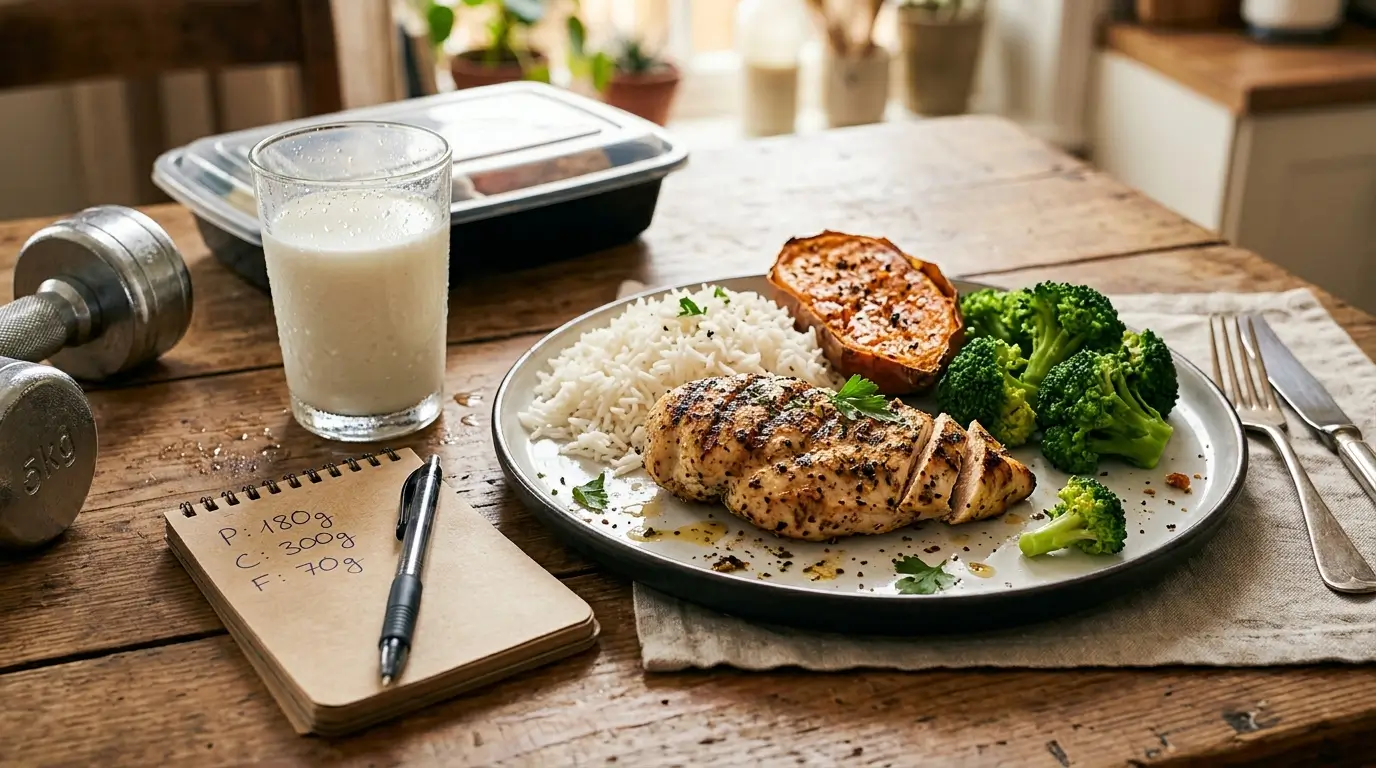
Building muscle requires two things: a small calorie surplus and enough protein to give your body raw material to build with. Most people get one of these right and the other catastrophically wrong. Either they undereat and wonder why progress is slow, or they overshoot the surplus by 500 to 1,000 calories a day and gain 3 lb of fat for every 1 lb of muscle.
This guide lays out the macro numbers that actually produce muscle growth with minimal fat gain, based on published research in the Journal of the International Society of Sports Nutrition and the evidence-based work of lean-mass researcher Eric Helms.
The Numbers
For most people training consistently for muscle growth:
- Protein: 0.8 to 1.0 g per lb bodyweight per day
- Fat: 0.4 to 0.5 g per lb bodyweight per day (minimum for hormone function)
- Carbs: fill the rest of your calorie surplus
Calorie surplus size depends on your training age:
| Training experience | Surplus | Expected muscle gain |
|---|---|---|
| Beginner (0 to 1 year) | 10 to 15% above TDEE | 1 to 2 lb per month |
| Intermediate (1 to 3 years) | 5 to 10% above TDEE | 0.5 to 1 lb per month |
| Advanced (3+ years) | 3 to 5% above TDEE | 0.25 to 0.5 lb per month |
Swipe to see more →
Bigger surpluses do not produce faster muscle growth past a certain point. The body can only build so much muscle tissue per month, and extra calories just add fat. The "see food diet" approach of "eat as much as possible to get big" is mostly fat gain in disguise.
Why Protein Is the First Variable
Muscle protein synthesis is the process of building new muscle tissue. It requires amino acids from dietary protein. A meta-analysis of 49 studies by Morton et al. (2018) in the British Journal of Sports Medicine concluded that protein intake above roughly 1.6 g per kg (0.73 g per lb) produces no additional benefit for muscle growth in most adults.
That said, many practitioners recommend 0.8 to 1.0 g per lb because it provides a safety margin, improves satiety, and comes with no downsides for healthy kidneys. At 180 lb, that is 145 to 180 g of protein per day.
Protein should be spread across 3 to 5 meals at roughly 30 to 50 g per meal, which maximizes the muscle protein synthesis response to each feeding.
Why Fat Has a Minimum, Not a Target
Fat below about 0.3 g per lb bodyweight (roughly 20% of calories) consistently shows hormonal suppression in males, particularly testosterone. In a surplus with no sex-hormone concerns, most men do well at 0.4 to 0.5 g per lb. Women generally need slightly higher dietary fat for the same hormonal health, though the research there is less definitive.
Going higher than 0.5 g per lb just takes calories away from carbs, which is fine if you prefer a higher-fat diet but does not benefit muscle growth directly.
Why Carbs Are the Fuel
Carbs are the preferred fuel for high-intensity training, which is what builds muscle most effectively. They also refill muscle glycogen between sessions.
In a muscle-gain surplus, carbs typically land at 2.5 to 4 g per lb bodyweight per day. For a 180 lb intermediate lifter in a 10% surplus, that works out to:
- TDEE around 2,700 calories
- Surplus calories: 2,970 per day
- Protein: 162 g (0.9 × 180) = 648 calories
- Fat: 72 g (0.4 × 180) = 648 calories
- Carbs: (2,970 − 648 − 648) ÷ 4 = 419 g = 1,676 calories
Percentages: 22% protein, 22% fat, 56% carbs. This is a carb-forward ratio and is exactly what most muscle-gain research supports.
The "Lean Bulk" vs "Dirty Bulk" Debate
Lean bulk (5 to 10% surplus) produces slower weight gain and minimizes fat accumulation. Most bodybuilders and informed recreational lifters use this approach because the muscle-to-fat gain ratio is better.
Dirty bulk (20 to 30%+ surplus) produces faster weight gain but at roughly 1 lb muscle for every 2 to 3 lb fat. The extra fat then takes months to cut off, often accompanied by some muscle loss during the cut. Net result after a bulk-cut cycle is usually worse than lean bulking alone.
The lean bulk approach is almost always the better choice unless you are a competitive athlete in a sport where raw weight matters more than composition.
Worked Example: Intermediate Lifter
Subject: 32-year-old man, 175 lb, 5'10", moderately active (lifts 4x per week), TDEE of 2,600 calories. Goal: gain muscle.
Surplus size. Intermediate lifter, 8% surplus = 2,600 × 1.08 = 2,808 calories per day.
Protein. 175 × 0.9 = 158 g = 632 calories.
Fat. 175 × 0.4 = 70 g = 630 calories.
Carbs. (2,808 − 632 − 630) ÷ 4 = 386 g = 1,546 calories.
Daily targets: 2,810 cal, 158P / 70F / 386C. Spread across four meals at roughly 700 calories each.
Expected gain: 0.5 to 1 lb per month, mostly muscle, minimal fat. Over a 6-month bulk, that is 3 to 6 lb gained with a good muscle-to-fat ratio.
Meal-Timing Notes
You do not need to hit every meal within a specific window to build muscle. The old "anabolic window" idea (protein within 30 minutes post-workout) has been largely debunked by research showing much wider windows (2 to 4 hours before and after training).
What does matter: hitting your daily protein target, spreading it across multiple meals, and eating enough total calories. Timing around workouts is a secondary optimization that matters only once the basics are locked in.
Adjustments If Progress Stalls
Weigh yourself weekly at the same time. After 2 to 3 weeks:
- Gaining 0.5 to 1 lb per week: on track for beginner, fast for intermediate
- Gaining 0.25 to 0.5 lb per week: ideal for intermediate
- Gaining over 1 lb per week after month 1: reduce surplus, too much fat gain
- Not gaining after 2 to 3 weeks: increase carbs by 100 to 150 calories per day
When to Stop Bulking and Start Cutting
Most informed lifters cap bulks at 12 to 16% body fat for men and 20 to 25% for women before switching to a cut. Bulking past those ranges makes cutting longer and puts more muscle at risk during the eventual deficit. Plan for 2:1 or 3:1 bulk-to-cut cycles (2 to 3 months bulking, 1 month cutting) rather than 12-month perma-bulks.
For the cutting phase, our how to calculate macros for weight loss guide covers the math in detail, and cutting vs bulking macros compares the two phases directly.
Tools
The DrinkDigits Macro Calculator runs TDEE, surplus, and macro split in one step for any goal. If you are newer to macros generally, start with macros explained. For protein source selection (dairy, whey, plant, mixed), our Protein Quality Score guide explains how to evaluate what you are eating.
Sources & References
- Morton RW et al., Br J Sports Med (2018). Meta-analysis on protein intake and muscle growth.
- Helms ER et al., J Int Soc Sports Nutr (2014). Evidence-based recommendations for natural bodybuilding.
- International Society of Sports Nutrition: Protein Position Stand. Peer-reviewed protein timing and dosing.
- NIH Office of Dietary Supplements: Protein. Government reference for protein intake.