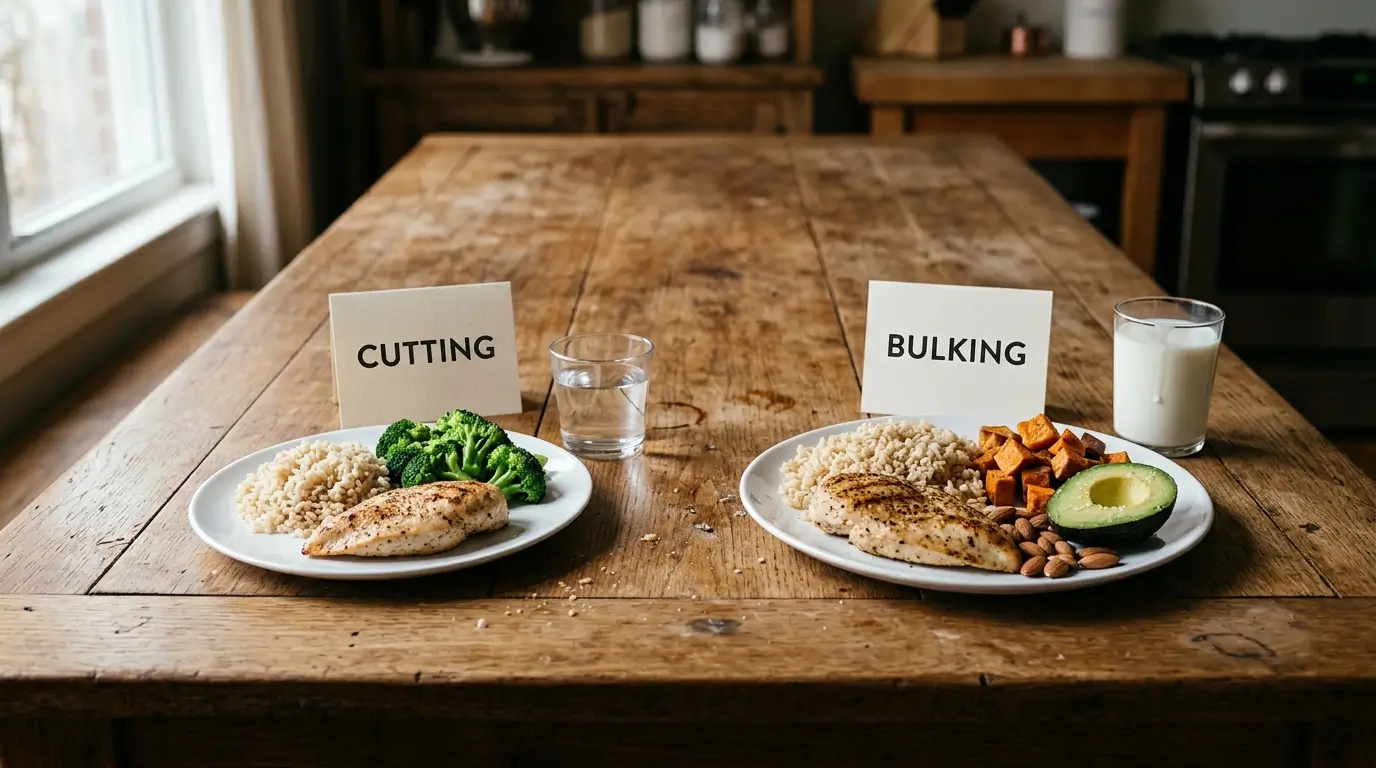
Cutting and bulking use the same three macros (protein, carbs, fat) but with different calorie targets and different priorities. Protein stays roughly the same. Fat shifts slightly. Carbs do most of the moving. The biggest variable, though, is total calories.
This guide compares the two phases side by side so you can see exactly what changes when you switch from one to the other, and why.
The Quick Comparison
For a 170 lb adult:
| Variable | Cutting | Bulking |
|---|---|---|
| Calorie target | TDEE × 0.80 (20% deficit) | TDEE × 1.08 (8% surplus) |
| Protein (g per lb) | 0.8 to 1.0 | 0.8 to 0.9 |
| Fat (g per lb) | 0.3 to 0.4 (minimum) | 0.4 to 0.5 |
| Carbs (g per lb) | Fills remaining calories | Fills remaining calories (much more) |
| Expected weekly weight change | Lose 0.5 to 1% bodyweight | Gain 0.25 to 0.5% bodyweight |
Swipe to see more →
The phase determines calorie target. Macros respond to calories. Protein changes the least because its job (muscle preservation or muscle building) is similar in both phases.
Calories: The Biggest Difference
Cutting and bulking are defined by calorie direction. Cutting means eating below your TDEE (Total Daily Energy Expenditure). Bulking means eating above it. If you do not know your TDEE, see our TDEE vs BMR explained guide.
Standard recommendations:
Cutting deficit sizes
- 15% below TDEE: slow and sustainable, lowest muscle loss risk
- 20% below TDEE: moderate, standard recommendation
- 25%+ below TDEE: aggressive, higher muscle loss risk
Bulking surplus sizes
- 3 to 5% above TDEE: advanced lifters (slower gain, minimal fat)
- 5 to 10% above TDEE: intermediate lifters
- 10 to 15% above TDEE: beginners (fastest gains, still lean)
Beyond 15% surplus or 25% deficit, diminishing returns kick in. The math stops producing extra muscle or extra fat loss, only extra fat (in a surplus) or extra muscle loss (in a deficit).
Protein: Stays Roughly the Same
Protein recommendations overlap significantly between cutting and bulking because protein serves similar purposes in both. During a cut it preserves muscle. During a bulk it provides building material for new muscle. Both contexts are served by the 0.7 to 1.0 g per lb range.
Slight nuance: some research supports pushing protein higher during aggressive cuts (up to 1.2 g per lb) to protect against muscle loss. And during bulks, dropping to 0.7 to 0.8 g per lb can free up calories for carbs, which may actually help training performance.
For most people, locking protein at 0.8 to 0.9 g per lb across both phases works fine.
Fat: Moderate Shift
During a cut, fat goes to the minimum that preserves hormone function, which is roughly 0.3 g per lb bodyweight. This frees up calories for carbs (which support training) and satiating protein. Women sometimes need slightly higher fat (0.35 to 0.4 g per lb) for hormonal reasons.
During a bulk, fat moves up to 0.4 to 0.5 g per lb. This is not because fat is required for muscle gain specifically, but because higher fat intake supports testosterone, makes food more enjoyable, and adds calories efficiently (9 per gram versus 4 for carbs).
Going far above 0.5 g per lb during a bulk just takes carbs away. That is fine as a preference but does not benefit muscle growth.
Carbs: The Swing Variable
Carbs absorb most of the calorie change between phases. In the 170 lb example:
Cutting (20% deficit, TDEE 2,500, target 2,000 cal):
- Protein 150 g (600 cal)
- Fat 60 g (540 cal)
- Carbs 215 g (860 cal)
Bulking (8% surplus, same TDEE, target 2,700 cal):
- Protein 150 g (600 cal)
- Fat 80 g (720 cal)
- Carbs 345 g (1,380 cal)
Protein stays identical. Fat moves 20 g. Carbs move 130 g. This is typical: carbs are the flexible macro that absorbs most of the surplus or deficit.
Higher carbs during a bulk support heavier training, faster glycogen replenishment, and more willingness to push through tough workouts. Lower carbs during a cut keep calories down while still leaving room for decent training performance.
Training: Similar in Both Phases
The actual training should not change much between cutting and bulking. Keep lifting heavy. Keep progressing when possible. The main difference is that a surplus allows for more sets per muscle group and faster recovery between sessions. A deficit reduces recovery capacity, so some lifters pull back on total volume by 10 to 20% during a cut.
Cardio is the opposite: usually higher during a cut (to create a deficit without cutting food too aggressively) and lower during a bulk (to conserve calories for muscle growth).
When to Switch Between Phases
End a cut when:
- You hit your target body fat percentage
- You are lean enough to start a bulk without going past 15 to 16% body fat for men or 22 to 25% for women
- You have been in a deficit for 12-plus weeks and need a metabolic break
- Hunger, sleep, or training performance drops sharply
End a bulk when:
- You have added 5 to 10% of your starting body weight
- Body fat is approaching 15 to 16% (men) or 22 to 25% (women)
- You have been in a surplus for 4-plus months
- Progress has slowed and you are gaining mostly fat
Typical cycle: 12 to 16 weeks cutting, 16 to 24 weeks bulking, repeat. This is far more effective than perpetual "lean gains" because each phase has a clear focus.
The Middle Ground: Recomposition
Recomposition (recomp) is eating at or near maintenance while training to slowly lose fat and gain muscle simultaneously. It works mainly for beginners, people returning from a training break, or those with high body fat who have never lifted consistently.
For intermediate lifters, recomp typically produces slower total progress than alternating cutting and bulking phases. The math favors cycling because each phase is dedicated to one goal.
Recomp macros sit between cutting and bulking: around 0.8 to 1.0 g protein per lb, 0.4 g fat per lb, carbs filling remaining calories at TDEE exactly.
When Not to Cut or Bulk
Some situations call for maintenance rather than actively pursuing either phase:
- Stressful life events (job change, new baby, major surgery recovery)
- Chronic sleep deprivation
- Active injury or illness
- Extended low-energy or low-motivation periods
Dieting and bulking both require consistency, which is hard when life is chaotic. Maintenance at TDEE preserves what you have and costs nothing to come back from.
Tools
Use the DrinkDigits Macro Calculator to get TDEE and macro targets for any goal (cut, maintain, or bulk). For a deeper breakdown of the weight-loss math, see how to calculate macros for weight loss. For the muscle-gain math in detail, our best macro ratios for muscle gain guide covers surpluses, meal timing, and lean-bulk specifics.
Sources & References
- Helms ER et al., J Int Soc Sports Nutr (2014). Evidence-based recommendations for natural bodybuilding covering both cutting and bulking.
- Morton RW et al., Br J Sports Med (2018). Meta-analysis on protein intake and muscle growth.
- International Society of Sports Nutrition: Diets and Body Composition Position Stand. Peer-reviewed comparison of dieting strategies.
- NIH Office of Dietary Supplements: Protein. Government reference for daily protein recommendations.